
In This Article
Two soaps walk into a Canadian bathroom in January. One is a heavy, stamped cube that smells faintly of olive groves. The other is a bottle covered in tiny, wildly enthusiastic text. Both claim to be gentle, plant-based, biodegradable and absurdly versatile. So which one earns the spot beside your sink?

That is the real question behind Marseille soap vs castile soap, and it is more interesting than it looks. The two share a family tree. Castile soap is an olive oil-based hard soap named for Spain’s Castile region, and Marseille’s soapmakers worked in that same Mediterranean tradition. Yet they behave differently once they meet water, winter-dry skin and a pile of salt-stained parkas.
Here is the short version. Marseille soap is a firm, cauldron-cooked cube built for longevity. It works as a hand soap, a laundry stain bar and a general household workhorse. Castile soap, as most Canadians meet it today, is either a softer, glycerin-rich bar or a concentrated liquid you dilute for everything from dishes to dog baths. Both can be excellent. They just excel at different jobs.
A quick note on method. This guide draws on published ingredient lists, maker histories and retailer product descriptions, not hands-on testing. Prices appear as approximate Canadian-dollar ranges because they shift constantly, and availability on Amazon.ca can vary by listing, so check before you buy.
Marseille Soap vs Castile Soap: Quick Comparison Table
| Feature | Marseille soap (traditional cube) | Castile soap (bar or liquid) |
|---|---|---|
| Typical oils | Olive and/or other vegetable oils; traditionally stamped at 72% oil | Traditionally olive oil; modern versions often add coconut, hemp or jojoba |
| Main form | Dense, stamped cube | Bar or concentrated liquid |
| Texture | Hard, slow to dissolve | Bars are softer; liquid is pourable |
| Glycerin | Largely washed out in the traditional process; traces remain | Typically retained, so more moisturizing |
| Scent | Plain and earthy, or lightly perfumed | Unscented or essential-oil scented |
| Daily-use strength | Long-lasting; excellent for stains | Versatile; liquid needs dilution |
| Best For | Laundry stains, hand washing, minimalists | Body and hair, dish and surface cleaning, refill-minded households |
Looking at the table, the biggest practical divide is glycerin and hardness. A cube that stays firm for months suits laundry and stain duty, while a glycerin-rich castile suits skin that complains in February. Neither is “better.” It depends on whether you want a durable tool or a gentle, flexible cleanser.
💬 Just one click — help others make better buying decisions too!😊
Top 7 Marseille Soap and Castile Soap Picks for Canada: Expert Analysis
The seven picks below cover both sides of the divide: four Marseille-style cubes and three castile options. They span budget to premium. The commentary comes from the specs, the ingredient lists and what makers and retailers say about each product. One honest caveat applies throughout: I could not verify aggregated Amazon.ca review data for these listings at the time of research, so where review sentiment is thin I say so rather than invent it.
1. Marius Fabre Olive Oil Marseille Soap Cube — the benchmark green cube
Marius Fabre has cooked soap in Salon-de-Provence since 1900, and four generations of the family still run it. Its olive oil cube is sold in roughly 100 g, 200 g and 400 g sizes. The ingredient list reads sodium olivate, sodium cocoate, aqua, glycerin, sodium chloride and sodium hydroxide. In plain language, that is saponified olive and coconut oils, a little salt, and lye that has already reacted into soap. The maker cites a 72% olive oil content and states there is no palm oil, added fragrance, colouring or preservatives.
What that means in practice: coconut oil supplies the lather, while olive oil supplies mildness and a firm body. Based on the spec comparison, this is the cube to pick if you want one bar that washes hands, tackles a coffee-stained cuff and sits happily in a guest bath. Retailer descriptions admit the natural scent is earthy or grassy and may not appeal to everyone, so sniff-sensitive households should keep that in mind.
On review sentiment, I could not verify aggregated Amazon.ca ratings. Retailer write-ups consistently emphasize the soap’s simplicity and gentleness, so check the live reviews before ordering.
Pros:
- ✅ Traditional 72% olive oil recipe, palm-free
- ✅ No added fragrance, colour or preservatives
- ✅ Versatile for hands, body and stains
Cons:
- ❌ Earthy, grassy scent isn’t for everyone
- ❌ Plain cube needs a draining dish
Expect roughly C$9–C$16 for a 200 g cube. That is a solid value verdict for the benchmark of the category.
2. Fer à Cheval Pure Olive Savon de Marseille Cube — oldest house, heftiest cube
Fer à Cheval is often described as Marseille’s oldest continuously operating soap house, with retailer histories dating it to 1856. Its 300 g pure olive cube is cooked in cauldrons for close to ten days. The brand cites the 1688 Edict of Colbert as its recipe tradition and says the soap contains no fragrance, colourants, preservatives or animal fats. The company has also received France’s EPV “living heritage” recognition, according to retailer material.
Why the numbers matter: 300 g is a lot of soap. A dense cube that size dissolves slowly, so one purchase can last through a long Canadian winter of hand washing plus laundry spot-treating. The brand calls it hypoallergenic, but that is a marketing claim rather than a guarantee, so a patch test on a small area of skin is still smart.
Here is what to weigh: this is the cube for households that want authenticity and volume. It is less “sniff and swoon” and more “reliable, serious soap.” Many listings come as two-packs, which raises the upfront cost while improving the cost per gram.
Review data was not verifiable for Amazon.ca at the time of research, so lean on the live listing for current feedback.
Pros:
- ✅ Large 300 g cube with excellent longevity
- ✅ Cauldron-cooked, pure olive recipe
- ✅ Fragrance-free for scent-sensitive homes
Cons:
- ❌ Multi-pack pricing raises the upfront spend
- ❌ Plain look suits utility more than gifting
Plan on roughly C$16–C$24 per 300 g cube, or about C$30–C$42 for a two-pack. It earns its premium on longevity.
3. Marius Fabre Marseille Laundry Soap Cube — palm-free stain specialist
This 400 g cube swaps palm oil for oleic sunflower oil, an oil the maker says is close to olive oil in composition. It is paired with coconut oil. Retailer specs put the cube at about 7.3 cm square, and the ingredients include sodium sunflowerseedate and sodium cocoate. The brand pitches it for delicates, including wool, silk and lace, as well as stubborn stains.
Interpretation: this is a modern Marseille-method soap rather than an olive-oil purist’s pick, so be honest with yourself about what you are buying. It trades the olive oil tradition for palm-free sourcing and strong stain performance. Rub it straight onto greasy marks or shirt collars before machine washing, or work it into foam for hand washing. Retailers also note the cube is suitable on hands, face and body.
A useful reality check from one retailer: the cube is recommended for spot treatment and hand washing, while flakes or liquid are suggested for full machine loads. So think of this as a stain stick, not a detergent replacement.
Review sentiment could not be verified for Amazon.ca, so check the live listing.
Pros:
- ✅ Palm-oil-free with sunflower and coconut oils
- ✅ Large 400 g size for heavy stain duty
- ✅ Gentle enough for delicates, per the maker
Cons:
- ❌ Not an olive oil cube, so less traditional
- ❌ Better for spot-treating than full loads
Budget roughly C$14–C$24. That is good value if stains, not skincare, are your priority.
4. Le Sérail Lavender Savon de Marseille Cube — fragranced, giftable, antique-moulded
Le Sérail has been making soap in Marseille since Vincent Boetto founded it in 1949. Its factory keeps period equipment, and a maître savonnier needs about two weeks to complete a batch, according to a French home-goods retailer that visited the site. The lavender cube is described as a five-step process using natural oils and crushed lavender blooms, pressed in antique moulds. A rose version includes crushed petals.
What it means for you: these coloured, scented cubes are a different proposition from the plain green bars. They are brilliant for guest bathrooms, linen drawers and gifts, because they look like something from a Provençal market stall. They are a poorer fit for fragrance-sensitive households or for anyone wanting a no-frills laundry bar.
An honest note on scale: sizes vary by listing, so compare grams per dollar rather than assuming parity with the 300 g cubes above.
I could not verify Amazon.ca review summaries for this item, so read the current reviews for scent strength and cube size.
Pros:
- ✅ Pretty, scented cube pressed in antique moulds
- ✅ Strong Marseille factory heritage since 1949
- ✅ Ideal for gifting and guest baths
Cons:
- ❌ Fragranced, so not for sensitive noses
- ❌ Sizes vary, so value needs checking
Expect roughly C$8–C$15 per cube, depending on size. It is a fair value for gifting.
5. Dr. Bronner’s Pure-Castile Bar Soap — castile with organic oils, in bar form
Dr. Bronner’s bar is the castile entry in solid form. In the peppermint-style versions, ingredients include saponified organic coconut, palm and olive oils with retained glycerin, plus organic hemp and jojoba oils, salt, citric acid and vitamin E. The brand says it skips chelating agents, dyes and synthetic fragrance, and wraps each bar in post-consumer recycled paper.
What the ingredient list implies: coconut and palm give the thick lather, while olive, hemp and jojoba add conditioning, and retained glycerin is the reason many people find castile bars kinder to dry skin. The trade-off is texture. Glycerin-rich bars soften when they sit in water, so a draining dish is non-negotiable. Also note that this is a blended-oil castile, not the pure olive oil of the historical definition.
The brand markets the bar for face, body and hair. Mint-style scents can feel tingly on the face, so a fragrance-free version is the safer pick for sensitive skin.
Verified aggregate review data was not available for Amazon.ca, so rely on the live listing.
Pros:
- ✅ Organic oils with retained glycerin
- ✅ Doubles as body, face and hair soap
- ✅ Recycled paper wrapper reduces waste
Cons:
- ❌ Softens quickly in a wet soap dish
- ❌ Minty scents can sting sensitive faces
Budget roughly C$5–C$9 per 140 g bar, lower in multipacks. It is a good value for a multi-use bar.
6. Dr. Bronner’s Pure-Castile Liquid Soap — the concentrated all-rounder
The liquid is the castile everyone has seen. The brand calls it about three times more concentrated than most liquid soaps and says it is made with over 70% certified organic and fair trade ingredients. Its own dilution cheat sheet suggests roughly one part soap to three parts water for body wash. For washing dishes by hand, it suggests pre-diluting one part soap with ten parts water. For a surface spray, it suggests about a quarter cup of soap in four cups of water.
The analysis: concentration is the whole value proposition. One 946 mL (32 oz) bottle turns into many litres of finished product. The catch is that dilution is a skill. Too strong, and you get residue or a slippery film. Too weak, and nothing foams. Two cautions apply. Do not pour castile into a dishwasher, and do not mix it with vinegar in the same bottle. The acid can undo the soap’s cleaning action, which is why the maker’s guide treats vinegar as a separate follow-up rinse.
For Canadian homes with hard tap water, expect some film on glass and tubs. Rinse well, and consider a separate acidic rinse afterward.
Amazon.ca review summaries could not be verified here, so check the current listing.
Pros:
- ✅ Highly concentrated, so one bottle goes far
- ✅ Replaces hand soap, body wash and dish soap
- ✅ Organic, fair trade ingredients per the brand
Cons:
- ❌ Needs correct dilution to avoid residue
- ❌ Can leave film in hard water
Plan on roughly C$22–C$34 for 946 mL. The cost per litre of finished soap is very low.
7. Kirk’s Original Coco Castile Bar Soap — coconut-oil castile on a budget
Kirk’s has been making coconut-oil castile since 1839, and its ingredients are brief: sodium cocoate, water, glycerin, sodium chloride, sodium gluconate and fragrance. The 113 g (4 oz) bar is made in the USA, and retailer pages cite vegan, Non-GMO Project and Leaping Bunny credentials. The brand says it lathers even in hard water.
Why that matters in Canada: plenty of prairie and southern Ontario homes deal with hard tap water, so a soap that foams without a scummy fight is a real advantage. Sodium gluconate is a chelating ingredient commonly used to help soaps cope with minerals, which fits the hard-water claim. Purists will point out that traditional castile means olive oil, and Kirk’s is coconut-based. Call it “castile-style” and you are being accurate.
Amazon.ca availability and review figures were not verifiable at research time, so confirm both on the listing.
Pros:
- ✅ Very low cost per bar
- ✅ Lathers well in hard water, per the brand
- ✅ Simple, short ingredient list
Cons:
- ❌ Coconut-only, not traditional olive castile
- ❌ Fragranced, so not for strict sensitivity
Expect roughly C$3–C$6 per bar, or about C$8–C$14 for a three-pack. It is the best value here.
| Product | Type | Key oils | Size (typical) | Approx. price range | Best For |
|---|---|---|---|---|---|
| Marius Fabre olive cube | Marseille cube | Olive, coconut | 100–400 g | C$9–C$16 (200 g) | Hands, body, all-round use |
| Fer à Cheval cube | Marseille cube | Olive | 300 g | C$16–C$24 | Long-lasting households |
| Marius Fabre laundry cube | Marseille-method cube | Sunflower, coconut | 400 g | C$14–C$24 | Stain removal, delicates |
| Le Sérail lavender cube | Scented Marseille cube | Natural oils, lavender | Varies | C$8–C$15 | Gifts, guest baths |
| Dr. Bronner’s bar | Castile bar | Coconut, palm, olive, hemp, jojoba | 140 g | C$5–C$9 | Face, body, hair |
| Dr. Bronner’s liquid | Castile liquid | Coconut, palm, olive | 946 mL | C$22–C$34 | Dishes, surfaces, refills |
| Kirk’s bar | Coconut castile bar | Coconut | 113 g | C$3–C$6 | Budget, hard water |
Reading across the table, the Kirk’s bar wins on sheer price per bar, while the Fer à Cheval cube wins on solid-soap volume. If you want one purchase to cover both laundry and skin, the Marius Fabre olive cube is the safest middle path. Gift-minded buyers should note that the Le Sérail lavender cube is the only truly decorative option, and that the Dr. Bronner’s liquid is the only product here that effectively becomes several products.
What Is the Difference Between Marseille Soap and Castile Soap?
Marseille soap is a firm vegetable-oil soap cooked in cauldrons around Marseille under a tradition dating to the 1688 Edict of Colbert, stamped with its oil percentage, traditionally 72%. Castile soap is an olive-oil-based hard soap named for Spain’s Castile region, now also sold as concentrated liquid soaps built on coconut, olive or other plant oils.
Now the useful part. Both trace back to the Levant, where Aleppo soapmakers made hard soaps from olive and laurel oil. Castile soap dropped the hard-to-find laurel oil and became the original olive-only white soap. Marseille’s makers then refined their own methods and, over time, leaned on coconut and other oils for hardness and lather.
The practical difference comes down to process and glycerin. Marius Fabre explains that its soap is cooked for about ten days and rinsed repeatedly, so only a small amount of the natural glycerin remains. A Quebec soapmaker makes a similar point, noting that glycerin is removed from solid Marseille soap, while pure castile retains all of it. That is why a cube feels hard and economical, and why a castile bar often feels richer on the skin.
Also keep in mind that definitions are flexible. Purists say true castile is olive-only, while many brands now use “castile” for any vegetable-oil soap. Read the ingredients, not just the label.
Marseille Soap Uses: A Practical Guide for Canadian Homes
Here is where a cube earns its keep. This is the usage guide your Amazon listing never gives you.
Start with the right kind of dry. One master soapmaker quoted by a Marseille tourism site points out that a cube made the same day will dissolve entirely, while harder, drier soap is more economical. So buy your cubes early, let them sit somewhere dry and, once opened, rest them on a draining rack. Marius Fabre also advises letting the soap dry fully between uses to extend its life.
Stain pre-treatment (the signature use). Wet the garment, rub the cube directly on greasy marks, collars and cuffs, give it a few minutes to work, then wash as usual. The Marius Fabre laundry cube is built for this.
Hand-washing delicates. Work the cube into foam in cool water, rinse well, and dry flat. Use gentler soaps like the Fer à Cheval cube for wool and silk, always following the garment’s care label.
Everyday hand and body wash. A plain cube such as the Marius Fabre olive cube lathers quickly with coconut oil and rinses cleanly. Start with a patch test if you are sensitive.
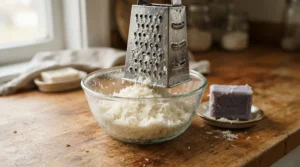
Make flakes for bigger jobs. Grating a cube into flakes helps it dissolve for hand-washing loads, a hack that suits small households.
Common mistakes in the first 30 days: leaving the cube in a puddle, using a fresh cube that melts away, and expecting a bar to replace a full laundry detergent for machine loads.
Real-World Scenarios: Which Soap for Which Canadian Household?
The Calgary renter on a C$25 budget. Tap water in much of the Prairies runs hard, and storage is tight. A Kirk’s bar for skin plus a Marius Fabre laundry cube for stains covers the basics for roughly C$17–C$30 total. The coconut-based bar leans on its hard-water formulation, and the cube handles the greasy cuffs. Frequency: daily bar use, weekly stain duty.
The Vancouver minimalist with a small bathroom. One bottle, many jobs. The Dr. Bronner’s liquid diluted for hand soap, dish soap and a surface spray replaces three products and fits a tiny cupboard. Budget about C$22–C$34 up front. The catch is learning dilution and rinsing glass thoroughly.
The Toronto host with gift-giving to do. A Le Sérail lavender cube for the guest bath and a Fer à Cheval cube for the kitchen sink cover looks and function. Budget roughly C$25–C$40 for both. Plain cubes also store well, which suits sporadic use.
The thread running through all three is simple: match the soap to the job, not the aesthetic.
Problem → Solution: Fixing the Most Common Soap Headaches
Problem: the bar turns to mush. Glycerin-rich bars like the Dr. Bronner’s bar soften in standing water. Use a draining dish, let it dry between uses, and cut large bars in half so one half rests.
Problem: skin feels tight in a dry Canadian winter. Many people find a glycerin-retaining castile gentler than a stripped, fully washed cube. Try the Dr. Bronner’s bar for the body, follow with moisturizer, and patch test anything new. If tightness persists or skin reacts, see a pharmacist or doctor.
Problem: film or scum in hard water. Soap and calcium do not get along. The Kirk’s bar is formulated with hard water in mind, and a separate acidic rinse afterward helps with glass and tubs. Never mix vinegar into the soap bottle itself.
Problem: stubborn grease on collars and cuffs. Rub the Marius Fabre laundry cube directly onto the stain before washing. Treat early, and repeat on old marks.
Problem: the earthy scent. Plain olive cubes smell like, well, soap and olives. If that bothers you, try the lightly fragranced Le Sérail lavender cube or an unscented castile.
French Soap-Making Heritage: From the 1688 Edict to Today’s Few Savonneries
The French soap-making heritage behind these cubes is genuinely old. Marseille’s soap production records go back to the 1370s, with a soapmaker named Crescas Davin recorded in 1371, and the first factories rose in the late sixteenth century. On 5 October 1688, the Edict of Colbert laid down how the soap could be made and labelled. Under it, makers used local ingredients: olive oil, sea salt and ash from saltwort plants in the Camargue.
The industry boomed. By the early twentieth century, production reached a reported peak of around 180,000 tonnes in 1913. In 1924, 132 soap makers still operated across Marseille, Toulon and Salon-de-Provence. Then it unravelled: imported oils, branded toilet soaps like Dop, Palmolive and Cadum, washing powders and washing machines pushed the traditional cube aside.
Today only a handful of savonneries still cook it the old way. One retailer lists Marius Fabre, Fer à Cheval, Le Sérail and Savonnerie du Midi, while other sources add a fifth name, so the exact number depends on who you ask. What survives is genuine craft. When you buy one of these cubes, you buy a sliver of that continuity, which is a decent reason to choose it over an anonymous bar.
Traditional French Soap Ingredients: What Is Actually in the Cube?
The traditional French soap ingredients are refreshingly short. Here is a decoder for the labels:
- Sodium olivate: saponified olive oil.
- Sodium cocoate: saponified coconut oil.
- Sodium palmate: saponified palm oil, used in some cubes.
- Sodium sunflowerseedate: saponified sunflower oil, used in palm-free versions.
- Sodium chloride: salt, used in the soapmaking and separation process.
- Sodium hydroxide: lye, which has reacted into soap rather than remaining free.
- Glycerin: a natural by-product that is mostly rinsed out in the traditional method, so only traces remain.
Here is the nuance buyers miss. The oft-quoted “72%” figure appears in different forms across sources. Some describe it as 72% vegetable oils, while Marius Fabre’s green cube states 72% olive oil. So read the stamp itself. French cubes made to the traditional rules are stamped on all six sides with the maker’s name, weight and oil percentage.
Also note that olive oil alone makes a soft, slow soap. Other oils are what let a bar clean properly, stay firm and still dissolve in water. That is why the best cubes pair olive with coconut.

Cube-Shaped Soap Bars: Why the Cube?
The cube-shaped soap bars you see in Marseille are not a styling choice. The soap is cut from larger blocks, stamped, and then dried, with some makers sun-drying the cut pieces. A cube is the easiest shape to cut, stamp on every face and stack for air circulation during drying.
There is a practical bonus. A cube’s flat faces stay put on a rack, and its density means it dissolves slowly. A large block can even be sliced to order. Marius Fabre sells a 2.5 kg block with a cheese wire for exactly that purpose.
Tips for using a cube well:
- Set it on a rack so all faces dry.
- Cut a big cube in half if you want one half for the kitchen and one for the bathroom.
- Grate off flakes for hand-washing laundry.
- Do not leave it in standing water, even a “hard” soap will soften.
For anyone who dislikes soap dishes, the cube’s heft also makes it easier to grip when wet than a slim bar.
Multi-Purpose Household Soap: Marseille Soap vs Castile Soap Head to Head
A multi-purpose household soap has to earn the label. Here is how each type handles common jobs.
In Canada, household cleaning products are classified as consumer products and covered under the Canada Consumer Product Safety Act, which typically requires bilingual labelling. That is a useful detail for imported French products, because most Marseille cubes arrive with French text already printed.
| Task | Traditional alternative | Marseille cube | Castile soap | Best For |
|---|---|---|---|---|
| Hand washing | Liquid hand soap | Firm lather, long-lasting | Gentle, glycerin-rich | Fer à Cheval cube or Dr. Bronner’s bar |
| Stain pre-treatment | Spray stain remover | Strong, direct rub | Less ideal | Marius Fabre laundry cube |
| Dishes by hand | Dish liquid | Possible, but awkward | Easy when diluted | Dr. Bronner’s liquid |
| Surface cleaning | All-purpose spray | Grate and dissolve | Dilute and spray | Dr. Bronner’s liquid |
| Hand-washing delicates | Delicates detergent | Mild, foams in cool water | Possible, mind residue | Marius Fabre olive cube |
Reading the grid honestly: liquid castile wins at anything that needs diluting or pouring, while cubes win at anything involving rubbing, scrubbing and storing. Neither replaces a good machine detergent for full loads, but both cut how many separate products you need. If you want one multi-purpose household soap that stays dry in a drawer for a year, the cube is the more forgiving choice.
How to Choose Between Marseille Soap and Castile Soap
Use these steps to narrow your pick:
- Decide the main job. Stains and hand-washing point to a cube, while dishes, surfaces and body wash point to liquid castile.
- Check your water. If your tap water is hard, favour a hard-water formula like the Kirk’s bar and plan to rinse thoroughly.
- Read the stamp and ingredients. Look for named oils, an oil percentage and a maker’s name, not just a French-sounding label.
- Match scent tolerance. Plain cubes are earthy; fragranced cubes like the Le Sérail lavender cube are lovely but not neutral.
- Compare cost per gram, not per bar. A 300 g cube and a 113 g bar are not comparable at face value.
- Plan the storage. Cubes need a dry spot, bars need a draining dish, and liquids need a labelled dilution bottle.
- Patch test first. Any new soap can irritate sensitive skin, so test a small area before committing.
Buying Authentic Marseille Soap in Canada: Labels, Regulations and Safety
Shopping for authentic Marseille soap in Canada means reading carefully. French lawmakers themselves have raised concerns about industrial producers using the “savon de Marseille” name on soaps that do not follow the traditional recipe, so the words alone prove little. Look for:
- A six-sided stamp with the maker’s name, weight and oil percentage.
- A named savonnerie such as Marius Fabre, Fer à Cheval or Le Sérail.
- Cauldron cooking and a Marseille-region origin stated clearly.
- A short, readable ingredient list with named oils.
On the Canadian side, rules vary by product category. Under the Cosmetic Regulations, cosmetic labels must carry specific information, including directions for safe use where a product presents an avoidable hazard. Laundry-labelled cubes fall closer to household consumer products. Rules differ for each, so treat any “hypoallergenic” claim as a marketing statement rather than a Health Canada finding.
Availability on Amazon.ca also varies. Some Marseille cubes ship from third-party sellers, so check seller, size and shipping before you order. For safety, keep soap away from eyes, store it out of children’s reach, and stop use if irritation develops.
Long-Term Cost and Maintenance: What You Really Pay Over a Year
Sticker price misleads in the soap aisle. Here is a rough, illustrative cost view using the price ranges above.
| Product | Typical size | Approx. price range | Value logic | Best For |
|---|---|---|---|---|
| Fer à Cheval cube | 300 g | C$16–C$24 | Roughly 7–8 cents per gram; dense and slow-dissolving | Long-term supply |
| Marius Fabre olive cube | 200 g | C$9–C$16 | Roughly 4–8 cents per gram; versatile single cube | Everyday all-rounder |
| Kirk’s bar | 113 g | C$3–C$6 | Roughly 3–5 cents per gram; very cheap | Tight budgets |
| Dr. Bronner’s liquid | 946 mL | C$22–C$34 | Dilution multiplies volume many times | Multi-use households |
The takeaway: cheapest upfront is not always cheapest per use. A well-dried cube lasts for months, while a bar left in a puddle disappears fast. Liquid castile looks pricey but stretches by dilution, so its real cost per litre of finished soap is low. To maximize value, buy cubes ahead, store them dry, rest bars on a rack and measure your dilutions instead of free-pouring.

FAQ
❓ Is Marseille soap safe for sensitive skin?
❓ Where can I buy authentic Marseille soap in Canada?
❓ Can I use castile soap and vinegar together?
❓ How long does a Marseille soap cube last?
❓ Which is cheaper, Marseille soap or castile soap?
Conclusion
So, who wins the Marseille soap vs castile soap showdown? Honestly, nobody, and that is the useful answer. Marseille soap is the durable specialist: dense, stamped, built for stains and long storage. Castile soap is the flexible generalist: glycerin-rich on skin, endlessly dilutable in liquid form and easy to stretch across a whole household.
If you want one cube, start with the Marius Fabre olive cube, the benchmark of the category. If volume and longevity matter most, the Fer à Cheval cube is the heavyweight, and if stains are your enemy, the Marius Fabre laundry cube is the specialist. If you want pretty and giftable, grab the Le Sérail lavender cube. On the castile side, the Dr. Bronner’s liquid is the multi-tasker, the Dr. Bronner’s bar is the skin-friendly option, and the Kirk’s bar is the budget hero for hard-water homes.
My honest suggestion for most Canadian households is to pair one cube with one castile product, then let your own water, skin and laundry pile decide the ratio. Prices and availability change, so check the live listings before you buy.
Recommended for You
- Aleppo Soap Laurel Oil: 7 Best Bars For Canadians In 2026
- Olive Oil Soap For Eczema: 7 Honest Picks (2026)
- Pure Castile Soap For Face: 7 Best Gentle Bars (2026)
Disclaimer: This article contains affiliate links. As an Amazon Associate, I earn from qualifying purchases. If you purchase products through these links, we may earn a small commission at no additional cost to you.
✨ Found this helpful? Share it with your friends! 💬🤗
