In This Article
Walk down the soap aisle of any Canadian drugstore and you’ll find a wall of neon gels promising 48 hours of “freshness.” Then there’s the Aleppo bar. It’s a rough-cut brick, green inside and tan outside, and it smells like a damp forest after rain. It has been cooked in cauldrons and cured in stacked towers for centuries, and it still holds its own against everything in that aisle. Aleppo soap laurel oil is the whole story here. Understanding it is the difference between a luxurious daily cleanser and an expensive doorstop.
What Is Aleppo Soap Laurel Oil?
Aleppo soap laurel oil is the defining pairing in Aleppo soap, a hard Castile-style bar. Olive oil is saponified with lye, then enriched with oil pressed from laurel berries. The laurel percentage printed on the bar, such as 20% or 40%, tells you how much of the oil blend is laurel. That number drives scent, strength and cost.
That’s the tidy version. The messy version is that bars with similar labels can differ wildly in laurel percentage, curing time and even country of origin. Canadian shoppers buying online can’t squeeze the bar before paying. This guide fixes that. You’ll get seven real bars compared on laurel strength and value, a traditional Aleppo soap review of each pick, an authentic Aleppo soap buying guide, and the Canadian context most US-centric roundups skip.
One transparency note before we dive in. Several of these bars surfaced in roundups covering Amazon’s marketplace, and listings, pack sizes and sellers rotate constantly. Confirm the exact amazon.ca listing, the laurel percentage on the label and the shipping origin before you buy. Prices below are ballparks in Canadian dollars, never quotes.
Quick Comparison: 7 Aleppo Soap Laurel Oil Bars Side by Side
| Product | Laurel / Olive | Bar Size | Best For |
|---|---|---|---|
| LYNPHA VITALE Aleppo Soap 16% | 16% / 84% | 7.05 oz (about 200 g) | First-time Aleppo users |
| Olippo Aleppo Soap 25% (2-pack) | 25% / 75% | Confirm on listing | Budget body cleansing |
| Naturally Anatolian Aleppo Soap (12-pack) | Not stated | 5.6 oz (about 160 g) | Families buying in bulk |
| JUSIZA Aleppo Soap 20% | 20% / 80% | 7 oz (about 200 g) | Balanced face and body use |
| Merlinera Aleppo Soap 3-Pack | 20% / 80% | 8 oz (about 227 g) | Everyday home use, longer cure |
| Cozy Soap Aleppo Soap Bar 30% | 30% / 70% | 7 oz (200 g) | Oily or combination skin |
| Sobeautis Natural Aleppo Soap 40% | 40% / 60% | 5 oz (about 140 g) | Scalp and odour control |
Laurel strength is the headline column. It climbs from 16% for the LYNPHA VITALE newcomer bar to 40% for the Sobeautis specialist. Every step up trades a little softness for more bite and herbal character. The Naturally Anatolian multi-pack offers the most flexibility for budgets, but its missing laurel percentage means you’re buying partly on trust. If you want to step up gradually, the Cozy Soap 30% bar sits neatly between the mild 20% bars and the 40% heavyweight.
💬 Just one click — help others make better buying decisions too!😊
Top 7 Aleppo Soap Laurel Oil Bars: Traditional Aleppo Soap Review
Each pick below gets a spec translation, an honest read on who it suits and a value verdict. A note on reviews: where I couldn’t verify a meaningful pool of amazon.ca customer reviews, I say so rather than guess.
1. LYNPHA VITALE Aleppo Soap 16% — gentlest on-ramp for newcomers
Think of 16% as the training-wheels setting for Aleppo soap laurel oil. The LYNPHA VITALE Aleppo Soap 16% blends 16% laurel with 84% olive oil in a 7.05 oz (about 200 g) bar. That olive-heavy ratio means a softer, creamier lather and a milder herbal scent. It also clears the roughly 16% mark that Wikipedia associates with higher-quality exports.
On paper, this suits skin that gets cranky in January, when furnace air and a minus-twenty wind team up against your face. Based on the spec comparison, you give up the sharper “clarifying” feel of a 30% or 40% bar and gain forgiveness. If you’ve never touched an Aleppo bar, this is where I’d start.
Reviewer sentiment: I couldn’t verify a deep pool of amazon.ca reviews at the time of research. Editorial roundups position it as the entry-level pick, so check the star distribution and recent comments on the live listing.
Pros:
- ✅ Olive-forward ratio keeps lather soft and mild
- ✅ Clear laurel percentage printed on the listing
- ✅ Lower-risk first step into Aleppo soap
Cons:
- ❌ Less pronounced laurel character than stronger bars
- ❌ Limited verifiable review data for Canadian buyers
Expect roughly C$12-C$20 per bar at the time of research. That’s fair value for a gentle starter, but check current price.
2. Olippo Aleppo Soap 25% (2-Pack) — budget pair with mid-strength laurel
The Olippo Aleppo Soap 25% is sold as a two-bar pack at 25% laurel and 75% olive oil. One retailer describes 25% as the point where bars give off that pleasant earthy laurel fragrance. So you get real character without the intensity of the 40% tier. Confirm the gram weight on the listing, because it wasn’t consistently published in the sources I reviewed.
Two bars matter more than they sound. Aleppo soap is meant to dry between uses, and a spare bar lets you rotate. The resting bar hardens and lasts longer, which stretches your dollars. Based on the numbers, this is a sensible body-and-hands bar for someone who wants more personality than 16% but isn’t chasing a treatment-strength soap.
Reviewer sentiment: roundups list it as an entry-level body-cleansing option, but I couldn’t verify a large body of amazon.ca reviews. Read recent comments for scent and crumbling complaints.
Pros:
- ✅ Two-bar pack enables a rotation routine
- ✅ 25% laurel offers noticeable herbal character
- ✅ Budget-friendly entry into mid-strength bars
Cons:
- ❌ Bar weight needs checking on the listing
- ❌ Thin verifiable review history
Think about C$18-C$30 for the pair. That’s good value if the bars match the listed size, but check current price.
3. Naturally Anatolian Aleppo Soap (12-Pack) — bulk value, handmade in Turkey
The Naturally Anatolian Aleppo Soap 12-Pack is the family-sized option, with 5.6 oz (about 160 g) bars handmade in Turkey. The catch is a big one: the laurel percentage isn’t stated on the label. You can’t compare it directly with the other bars here, so you’re buying on reputation and reviewer feedback.
It’s also made by a cold-process method, not the hot-process cauldron cooking of traditional Aleppo production. Cold-process bars can still be gentle and pleasant, but they’re a different craft. The bulk format has a hidden advantage, though. A shelf of spare bars quietly ages while you use one, and an extra month in the cupboard rarely hurts.
Reviewer sentiment: one roundup reports that verified buyers with eczema found it gentle enough for daily use without irritation or dryness. The same roundup notes a mild laurel scent. Treat that as one source, not proof.
Pros:
- ✅ Lowest cost per bar in this lineup
- ✅ Hand-cut irregularities suggest hand finishing
- ✅ Reviewers describe a mild, non-stripping feel
Cons:
- ❌ Laurel percentage isn’t printed on the label
- ❌ Cold process, not traditional hot process
A multi-pack like this typically lands around C$45-C$75, so check current price. The per-bar value is strong if you accept the unknown laurel level.
4. JUSIZA Aleppo Soap 20% — balanced mid-range, preservative-free
At 20% laurel and 80% olive oil, the JUSIZA Aleppo Soap 20% lands in the sweet spot many retailers recommend for daily use. One French retailer suggests 5-20% laurel for everyday routines, and this bar sits right at the top of that band. The 7 oz (about 200 g) bar is described in roundups as preservative-free.
What does that mean in practice? You get enough laurel to deliver the signature scent and a “cleaner” feel, with olive oil still doing most of the heavy lifting. Pack sizes vary between listings, with two-bar and four-bar versions turning up in different roundups. Compare cost per bar rather than headline price.
Reviewer sentiment: roundups praise the balance of cleansing and moisture retention. I couldn’t verify detailed amazon.ca review themes, so scan recent reviews for crumbling and delivery condition.
Pros:
- ✅ 20% laurel suits daily face and body use
- ✅ Preservative-free formulation per roundups
- ✅ Multi-pack options lower cost per bar
Cons:
- ❌ Pack configurations vary between listings
- ❌ Limited verifiable Canadian review data
Plan on roughly C$18-C$32 depending on pack size, so check current price. Strong all-round value for a first “real” Aleppo bar.
5. Merlinera Aleppo Soap 3-Pack — biggest bars, longer cure
The Merlinera Aleppo Soap 3-Pack pairs 20% laurel with 80% virgin olive oil in 8 oz (about 227 g) bars. That’s the largest bar in this lineup. Roundups also cite a six-month cure. Longer curing generally means a harder bar that wears down slowly, which matters when a pack of three has to last a household.
Based on the spec comparison, this is the “set it and forget it” choice. The laurel level matches the JUSIZA, but you get more soap per bar and three bars to rotate. One caution: “virgin olive oil” is a marketing grade claim, and you can’t verify it from a photo. Treat it as a point in its favour, not a guarantee.
Reviewer sentiment: editorial roundups rank it as a top overall pick for everyday home use. That’s editorial opinion, not aggregated customer data, so read the live reviews for scent, texture and packaging notes.
Pros:
- ✅ Largest bars in this lineup
- ✅ Six-month cure reported by roundups
- ✅ Three-pack suits rotation and household sharing
Cons:
- ❌ Higher upfront cost than single bars
- ❌ “Virgin olive oil” claim is hard to verify
Think C$30-C$50 for the trio at the time of research. Good value per gram if you’ll actually use three bars, but check current price.
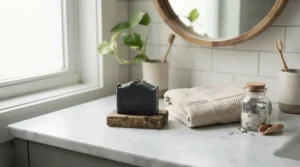
6. Cozy Soap Aleppo Soap Bar 30% — clarifying step-up with a full ladder
The Cozy Soap Aleppo Soap Bar 30% offers 30% laurel and 70% olive oil in a 7 oz (200 g) bar. It’s described on the listing as a clarifying blend for normal skin. The smart detail is that Cozy Soap sells the same format across a ladder of laurel levels, from 10% up to 60%. You can start here and move up or down without changing brands.
That consistency is underrated. When you switch brands, you also switch curing time, olive oil quality and scent, so you never know which variable changed your skin’s mood. With one brand and one bar shape, the laurel percentage is the only thing you’re testing. For oily or combination skin, 30% is a reasonable midpoint.
Reviewer sentiment: I couldn’t verify a robust amazon.ca review pool for this specific listing, and price-tracker data suggests many of the listings are sold by marketplace sellers. Confirm the seller and shipping origin.
Pros:
- ✅ Clear 30% laurel level on a 200 g bar
- ✅ Same-format ladder from 10% to 60%
- ✅ Handy midpoint for oily or combination skin
Cons:
- ❌ Marketplace-seller listings can change
- ❌ Limited verifiable review history
Expect around C$18-C$28 per bar. That’s reasonable for the strength, but check current price.
7. Sobeautis Natural Aleppo Soap 40% — strongest laurel for scalp and oily skin
The Sobeautis Natural Aleppo Soap 40% is the specialist here, with 40% laurel and 60% olive oil in a compact 5 oz (about 140 g) bar. Roundups frame it as a high-strength bar for odour control, scalp use and intensive cleansing. A retailer guide also asks the obvious question: why not 50%, 70% or even 100% laurel? The answer is that more laurel isn’t automatically better, and the soap’s character shifts.
In practice, expect a bolder herbal scent and a more assertive cleanse. That’s wonderful for some skin and too much for others. I’d patch test on the inside of your arm for a few days before it touches your face. The smaller bar also means you’re paying a premium per gram.
Reviewer sentiment: I couldn’t verify detailed amazon.ca review themes. Across retailer review pages for Aleppo bars generally, fans praise lather and scent while a minority report dryness or a strong leathery-herbal smell. Expect that split.
Pros:
- ✅ Highest laurel level in this comparison
- ✅ Compact bar suits scalp and targeted use
- ✅ Distinctive, unmistakable laurel character
Cons:
- ❌ Smallest bar and highest cost per gram
- ❌ Strong scent and cleansing power may dry some skin
Budget roughly C$18-C$30 for a bar. It’s worth it if you’ve outgrown milder soaps, but check current price.
Price Range & Value Analysis
| Product | Approx. Price Range (CAD) | Value Verdict | Best For |
|---|---|---|---|
| LYNPHA VITALE | C$12-C$20 | Fair for a gentle starter | Beginners |
| Olippo | C$18-C$30 (pair) | Good for two mid-strength bars | Budget body use |
| Naturally Anatolian | C$45-C$75 (12-pack) | Strong per-bar value, unknown laurel % | Families |
| JUSIZA | C$18-C$32 | Strong all-rounder | Daily face and body |
| Merlinera | C$30-C$50 (3-pack) | Best per-gram value | Households |
| Cozy Soap 30% | C$18-C$28 | Reasonable for the strength | Oily skin |
| Sobeautis | C$18-C$30 | Premium per gram | Scalp, odour control |
These ranges are approximations from the time of research, so verify them on the live listing. Value here is a cost-per-use story. The Merlinera and Naturally Anatolian packs give you the lowest cost per gram, but only if you’ll actually go through that much soap. For a first purchase, the JUSIZA or LYNPHA VITALE gives you the most information for the least risk.
Authentic Aleppo Soap Buying Guide: How to Choose and Avoid Imitations
Imitations aren’t new. Reporting from The National described a market flooded with look-alikes years ago, including laurel-and-olive soaps made far from Syria. Here’s how to shop smart.
- Read the laurel percentage first. It’s the single most useful number. If a listing doesn’t show one, treat that as a warning, not a detail.
- Check the ingredient list. Genuine bars are built from olive oil, laurel berry oil, water and lye, which appear on labels as sodium olivate and sodium laurate. A long list of extras suggests a different product.
- Be wary of added fragrance or colour. True laurel oil has a strong herbal scent and a distinctive green hue, so perfumed or dyed bars deserve suspicion.
- Treat origin claims with curiosity. Aleppo, Antioch and Nablus have all been soap-making centres, and some Syrian soap-makers now work in Turkey. “Made in Syria” alone isn’t a quality guarantee, so look for transparent maker details.
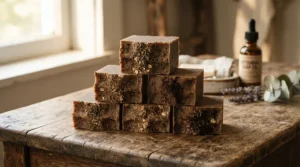
- Inspect the bar. Look for a rough-cut cube, often hand-stamped, with a green interior and tan exterior as the bar ages.
- Ask about curing. Bars cured six to twelve months are harder and last longer.
- Vet the seller. Check return policies, photos of the actual ingredient label and recent reviews mentioning crumbling or scent.
This is the heart of any authentic Aleppo soap buying guide: percentage, ingredients, transparency. If a listing nails those three, the rest is preference.
Laurel Berry Oil Explained: What It Is and What It Isn’t
Laurel berry oil is pressed from the berries of the laurel tree. It’s a true base oil that saponifies, turning into soap alongside olive oil. It is not bay laurel essential oil, which is distilled from leaves and works as a fragrance-strength ingredient. Mixing the two up is the fastest way to misread a label.
UNESCO’s entry on Aleppo ghar soap craftsmanship describes how families pick wild laurel berries in autumn and boil them until they split. The oil rises and is skimmed off. That labour-intensive step is why bars with more laurel berry oil cost more.
What does the oil actually do? Wikipedia notes that laurel oil is an effective cleanser with some antimicrobial, antifungal and anti-itching properties. Some retailers go further and promise relief for eczema or psoriasis. The evidence behind those bigger claims is thinner than the marketing suggests, so I’d treat them as traditional lore rather than medical fact. What laurel berry oil reliably delivers is the bar’s signature scent and character.
Percentage guidance is rule-of-thumb territory. One retailer suggests 5-20% for daily use, while a maker cited by another shop says treatment-style soap needs at least 15%. Neither is a formal standard. Choose your percentage by how your skin behaves, not by whichever number sounds most medicinal.
Traditional Soap-Making and Aged Soap Bars: Why Time Is an Ingredient
Traditional Soap-Making
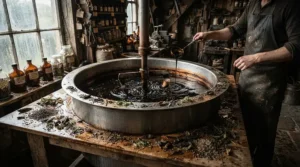
Traditional soap-making for Aleppo bars uses the hot process. Olive oil, water and lye go into a large vat, and the boil lasts around three days until the mixture becomes a thick liquid soap. Per UNESCO, the mixture is poured onto factory floors to cool. Craftsmen then cut the slab into cubes with a rake, using their body weight, and hand-stamp each one.
Aged Soap Bars
Aged soap bars are the second half of the story. UNESCO says stamped cubes are stacked in towers to dry for six to nine months, while Wikipedia gives a range of six months to a year. One Dutch retailer notes the bar loses about 30% of its water in the first nine months. Over time the interior shifts from green toward yellow, which is why a fresh-looking green bar is a clue about age.
Why does this matter when you’re clicking “add to cart”? A well-aged bar is harder, lasts longer in the shower and tends to lather more gently. A young bar can feel softer and dissolve faster. Since you can’t hold the bar, use the curing claims on the listing, like the Merlinera six-month cure, as a tiebreaker.
Aleppo Soap vs Marseille, Castile and Syndet Bars: Which Wins?
| Type | Main Ingredients | Typical Character | Best For |
|---|---|---|---|
| Aleppo bar | Olive oil plus laurel berry oil | Herbal scent, hard bar, strength varies by laurel % | Daily washing, face, body and hair |
| Marseille soap | Traditionally olive oil; modern versions may add other vegetable oils | Neutral, versatile | Household and body use |
| Castile soap | Olive oil and lye | Mild, plain | Sensitive-leaning skin |
| Syndet bar | Synthetic detergents, non-alkaline | Very mild | Eczema-prone or very dry skin |
Aleppo soap is the original in this family tree. Marseille soap is its descendant, and modern versions are often adapted with other vegetable oils. Aleppo bars, as French Soaps UK puts it, carry the added laurel oil as their distinguishing feature.
Here’s the honest caveat. The Pierre Fabre Eczema Foundation advises against soap for eczema-prone skin, since soap is a natural detergent that can dry skin, and points toward syndet products. Familiprix, citing the Canadian Dermatology Association, notes that liquid soaps are generally preferred over bars for eczema because they’re less abrasive and easier to rinse. So if you have diagnosed eczema, talk to your doctor before making an Aleppo bar part of your routine. For everyone else, an olive-heavy bar like the LYNPHA VITALE is a gentle way to find out how your skin reacts.
Safety and Regulations: What Health Canada Says About Soap Claims
In Canada, products represented for cleansing the skin fall under Health Canada’s cosmetics rules. Health Canada doesn’t approve cosmetics before sale, but manufacturers and importers must submit a Cosmetic Notification Form within 10 days of the first sale in Canada. The responsibility for safety sits with the company selling the product.
Claims matter too. Legal commentary notes that drug-like claims can push a product out of the cosmetic category and into stricter rules. That’s why you’ll often see careful wording on Aleppo soap labels and, conversely, why a listing promising to cure eczema or psoriasis should raise your eyebrows. Aleppo soap laurel oil bars are cleansers, and that’s the claim you can trust.
Practical takeaways for Canadian buyers: read the ingredient list, be sceptical of medical promises and patch test any new bar. If you buy from a marketplace seller shipping from outside Canada, it’s reasonable to ask whether the product has been notified to Health Canada. I couldn’t verify notification status for any of the bars above, so that’s a question for the seller. If a product causes a reaction, you can report health or safety concerns to Health Canada.
How to Use Aleppo Soap Laurel Oil: A Practical Guide for Your First 30 Days
Set it up right. Park the bar on a draining soap dish, not in a puddle. Aleppo bars are meant to dry between uses, which is part of why they last. Cut a large bar into two or three pieces so one is always resting.
Start gently. Lather in your wet hands rather than scrubbing the bar across your face. Keep the water warm, not hot, and keep showers short. The Eczema Society of Canada suggests five to ten minutes in warm water to avoid over-drying skin. Then moisturize, since moisturizer helps dry skin feel more comfortable, and Canadian winters are rarely kind to bare skin.
Patch test. Try the bar on your inner forearm for a few days before using it on your face, especially at 30% laurel or above.
Mistakes to avoid in the first month:
- Jumping straight to a 40% bar on dry facial skin
- Leaving the bar in standing water, where it turns mushy
- Using it on cracked or broken skin
- Expecting an instant hair-washing result, since Aleppo soap can be used as shampoo but your scalp may need a transition period
If your skin feels tight, step down to a lower percentage or use the bar only on hands and body. The right bar should leave you comfortable, not squeaky.
Which Aleppo Bar Fits Your Life? Three Real-World Scenarios
These are illustrative buyer profiles, not testimonials.
The winter-dry commuter. Picture someone in a prairie city with a C$20 budget, walking in minus-twenty wind and sitting in heated offices, washing daily. Dry, reactive skin points toward the olive-heavy LYNPHA VITALE 16% or the JUSIZA 20%. Pair it with a rich moisturizer.
The oily-skinned gym regular. Imagine a C$30 budget, daily workouts, and a scalp and back that get greasy. The Cozy Soap 30% is a sensible first step, with the Sobeautis 40% as an upgrade if that feels too mild. Patch test first, and rinse thoroughly.
The family of four. Think C$60-C$70 for the whole household, with different skin types and little patience for fiddly routines. The Merlinera three-pack or Naturally Anatolian twelve-pack gives everyone a bar. Use the larger bars for body washing and keep a milder bar like the JUSIZA for the kids’ hands and faces, once a doctor or pharmacist has no objection.
The pattern across all three: start lower than you think, then move up only if your skin asks for it.
FAQ
❓ Where can I buy Aleppo soap in Canada?
❓ How long does a bar of Aleppo soap last?
❓ Can I use Aleppo soap as shampoo?
❓ Is Aleppo soap good for eczema?
❓ Is Aleppo soap worth the price compared with regular castile soap?
Conclusion
Aleppo soap laurel oil is simple on paper and surprisingly nuanced in practice. The number printed on the bar tells you how much laurel berry oil you’re getting, and the curing time tells you how long the maker waited. Everything else is preference.
If you’re new, start with the LYNPHA VITALE 16% or the JUSIZA 20%. If you want to experiment, the Cozy Soap ladder lets you step up one laurel level at a time. Households will appreciate the Merlinera three-pack, while the Naturally Anatolian twelve-pack suits anyone happy to trade a printed laurel percentage for bulk savings. And if you’ve outgrown the gentle stuff, the Sobeautis 40% is the bold option, ideally after a patch test. For budget-minded rotation, the Olippo pair is an easy way to try 25%.
Whatever you choose, shop with your eyes open: read the percentage, scan the ingredients, question the origin story and ignore medical promises. Your skin will tell you the rest.
✨ Ready to find your perfect bar?
🔍 Browse the highlighted picks above to check current pricing and availability on amazon.ca. A few minutes of label-reading now means months of a better routine, so choose the bar that matches your skin, your budget and your winter!
Recommended for You
- Olive Oil Soap For Eczema: 7 Honest Picks (2026)
- Pure Castile Soap For Face: 7 Best Gentle Bars (2026)
- Castile Soap Vs Regular Soap: 7 Best Picks
Disclaimer: This article contains affiliate links. As an Amazon Associate, I earn from qualifying purchases. If you purchase products through these links, we may earn a small commission at no additional cost to you.
✨ Found this helpful? Share it with your friends! 💬🤗
