
In This Article
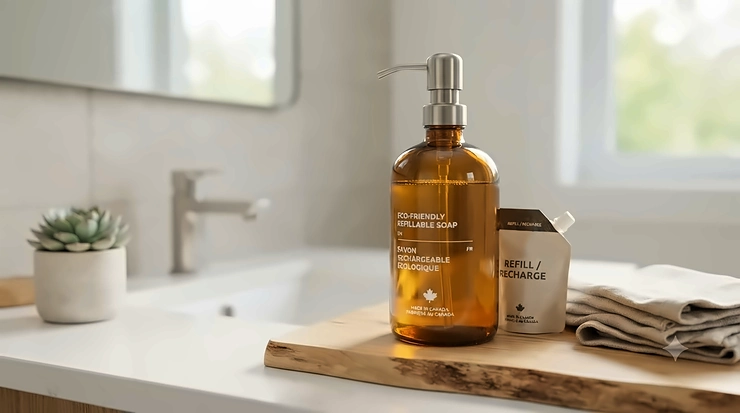
There’s a specific kind of guilt that hits you while you’re scrubbing your hands at the kitchen sink, watching the pump bottle wobble on its last few squirts before it’s destined for the blue bin — if it even makes it that far. Eco friendly refillable soap is any hand or body soap system designed to be reused rather than tossed: a permanent bottle or dispenser paired with low-waste refills, such as tablets, concentrates, or paper-based cartons, instead of a brand-new plastic bottle every few weeks. It’s a small swap, but it’s one of the few sustainability habits that actually sticks, because you don’t have to think about it twice — you just refill instead of rebuy.

Canadians throw out an enormous volume of personal care packaging every year, and bathroom products are some of the worst offenders because they’re small, used daily, and almost never get a second life. The federal government’s Single-use Plastics Prohibition Regulations are part of a broader push toward zero plastic waste by 2030, and household refill habits are exactly the kind of everyday shift that supports that goal. The good news is that the refill movement has matured well past the “weird hippie store with bulk bins” phase. You can now order genuinely well-designed, dermatologist-considered, scent-forward refillable soap systems straight to your door, and a few of them rival luxury bathroom brands in how they actually look sitting on your counter.
This guide breaks down seven real, currently available eco friendly refillable soap systems — spanning budget glass dispensers you fill yourself, mid-range tablet-and-concentrate kits, and a genuinely premium touchless option — with honest analysis of who each one suits, what reviewers consistently say about them, and where the real trade-offs are. We’ll also dig into plastic-free soap options that skip bottles entirely, decode environmental soap packaging claims that brands love to print on the box, and map out practical ways to reduce bathroom waste well beyond the sink. Prices are referenced in CAD ranges only, since Amazon pricing shifts constantly — always check the current price before buying.
Quick Comparison Table
| Product | Refill Type | Best For | Approx. Price Range (CAD) |
|---|---|---|---|
| Blueland Foaming Hand Soap Starter Set | Dissolvable tablet | Minimalist bathrooms, low storage space | C$20-C$30 |
| Grove Co. Foaming Hand Soap Starter Kit | Aluminum concentrate | Natural fragrance variety | C$20-C$28 |
| Skipper (formerly Tirtyl) Hand Wash Kit | Dissolvable tablet | Sensitive skin, travel | C$18-C$26 |
| Mrs. Meyer’s Foaming Hand Soap Starter Kit | Liquid concentrate | Easy first-time switch, drugstore familiarity | C$12-C$18 |
| Cleancult Liquid Hand Soap Refill | Paper carton | Heavy daily households | C$10-C$16 per refill |
| simplehuman Rechargeable Sensor Pump | Any liquid soap (BYO) | Touchless premium upgrade | C$60-C$90 |
| rejomiik Glass Foaming Dispenser (2-Pack) | Any liquid soap (BYO) | Tightest budget, DIY foaming soap | C$15-C$25 |
A quick scan of that table tells you most of what you need to know about where each product sits in the market: the tablet-based systems from Blueland and Skipper cluster in the mid-range and trade a bit more upfront cost for near-zero plastic shipped to your door, while Mrs. Meyer’s undercuts them on price by leaning on a familiar liquid concentrate format. The simplehuman pump is the clear outlier on price, but it’s solving a different problem entirely — touchless hygiene — not just plastic reduction. If your only goal is to stop buying disposable pump bottles, the rejomiik glass dispenser paired with bulk soap you dilute yourself is the cheapest entry point by a wide margin.
💬 Just one click — help others make better buying decisions too! 😊
✨ Found a system that fits your bathroom? Compare current pricing before the deal moves. 💬
Top 7 Eco Friendly Refillable Soap Picks: Expert Analysis
Picking a refillable soap system isn’t just about grabbing whatever has the prettiest bottle on Instagram. The real differences show up in how the refill format matches your household’s habits, how the dispenser holds up to daily abuse, and whether the lather actually performs the way a bar or bottled soap does. Below, all seven products are broken down with real specs, sourced review sentiment, and honest commentary on where each one earns its spot — and where it doesn’t.
1. Blueland Foaming Hand Soap Starter Set — best tablet system for minimalist bathrooms
Blueland built its entire reputation on the idea that you should never have to ship water across the country in a plastic bottle, and the Foaming Hand Soap Starter Set is the cleanest expression of that idea. The set ships with one glass “Forever Bottle” and a handful of compressed tablets that dissolve in warm tap water in a few minutes flat. Each tablet is engineered to produce roughly 9 fl. oz. of foaming soap, which in practice covers a single bathroom for four to six weeks of normal household use — a single small box of tablets effectively replaces several months of disposable bottles taking up space under your sink. The glass bottle itself uses a foaming pump mechanism, which matters more than it sounds: foaming pumps stretch a small amount of liquid soap into a much larger volume of lather, so you genuinely use less product per wash compared with a standard gel pump.
Based on the spec comparison with competing tablet systems, Blueland’s main strength is its scent range — Iris Agave and Lavender Eucalyptus consistently come up as reviewer favourites — paired with a formula that’s EPA Safer Choice certified and free of parabens and phthalates. This makes it a strong fit for households that want a “set it and forget it” system without sacrificing a spa-like scent experience. Reviewers consistently report that the tablets dissolve cleanly without leaving grit, and the compostable tablet wrapping is a small but appreciated touch that drugstore brands skip entirely.
✅ Tablets take up roughly 10x less storage space than bottled refills
✅ EPA Safer Choice certified, paraben and phthalate-free formula
✅ Wide, frequently rotating scent lineup for variety seekers
❌ Requires a foaming pump specifically — won’t work in a standard gel dispenser
❌ Tablet dissolving takes a few minutes, so it’s not instant like pouring liquid
In the C$20-C$30 range for the starter kit, Blueland delivers strong long-term value once you’re only buying refill tablets, making it one of the better mid-range picks for anyone tired of cluttered under-sink cabinets.
2. Grove Co. Foaming Hand Soap Concentrate + Glass Dispenser Kit — best all-natural scent variety
Grove Co. takes a different technical approach than Blueland: instead of a solid tablet, the concentrate ships in a small, infinitely recyclable aluminum bottle that you pour into the glass dispenser and dilute with water before pumping. The glass dispenser itself is partially made from recycled glass and pairs with a stainless-steel pump, which reviewers note feels noticeably sturdier than the plastic pump heads bundled with cheaper dispensers. What most buyers overlook about this system is the ingredient profile — Grove’s formula leans on roughly 97% plant-based ingredients, including aloe vera, which is part of why reviewers consistently mention that their hands feel less stripped after repeated daily washes compared with conventional foaming soaps.
The standout fragrance lineup (Lemon & Eucalyptus, Lavender Blossom & Thyme, and an unscented Free & Clear option) is formulated entirely with essential oils and plant extracts rather than synthetic fragrance blends, which matters if anyone in your household reacts to artificial scent. On paper, this means slightly more variability batch-to-batch than a synthetic fragrance would offer, but reviewers generally describe the scent as “natural” rather than “weak” — a meaningful distinction for anyone who’s tried unscented eco brands and found them underwhelming.
✅ 97% plant-based formula with aloe vera for less skin-stripping
✅ Aluminum concentrate packaging is infinitely recyclable, unlike most plastic
✅ Stainless-steel pump feels more durable than standard plastic pumps
❌ Requires manual dilution — you measure water yourself, more steps than a tablet
❌ Essential-oil scents fade faster than synthetic fragrance in some reviews
At around C$20-C$28 for the starter kit, Grove Co. lands solidly in the mid-range, and it’s a particularly good match for households already buying natural skincare products elsewhere.
3. Skipper (formerly Tirtyl) Hand Wash Single Kit Glass — best for sensitive skin and travel
Skipper rebranded from Tirtyl in 2024, but the core just-add-water tablet system stayed the same, and reviewers say the formula is still one of the gentlest on the market for dry or sensitive skin. The single kit includes one glass foaming dispenser and three tablet refills in a rotating selection of fragrance profiles, with each tablet dissolving into roughly 8 fl. oz. of foaming wash. What sets Skipper apart from Blueland on paper is its ingredient sourcing — every component is listed on the EPA’s Safer Chemical List, and the brand markets itself specifically around suitability for eczema-prone skin, a claim echoed in aggregated review sentiment from customers managing chronic dryness.
Here’s what the spec sheet won’t tell you, but reviewers note: the compostable tablet wrapping is genuinely small enough to toss a few spares into a toiletry bag, which makes Skipper one of the more travel-practical options on this list if you’re someone who hates packing liquids through airport security. The brand also runs an ocean-plastic offset program, claiming to collect roughly a pound of ocean-bound plastic per kit sold through a partnership with Plastic Bank — a nice-to-have rather than a core performance feature, but it does add a layer of accountability beyond the product itself.
✅ Formulated for sensitive and eczema-prone skin, per aggregated reviews
✅ Compact compostable tablets are genuinely travel-friendly
✅ Listed entirely on the EPA Safer Chemical List
❌ Like other tablet systems, only compatible with foaming pump dispensers
❌ Some reviewers note the lather is thinner than gel-based liquid soaps
Priced in the C$18-C$26 range for the single starter kit, Skipper competes directly with Blueland on value, with the edge going to sensitive-skin households specifically.
4. Mrs. Meyer’s Clean Day Foaming Hand Soap Dispenser & Concentrate Starter Kit — best widely available drugstore pick
Mrs. Meyer’s earns its spot here precisely because it isn’t a niche direct-to-consumer brand — it’s stocked in big-box and drugstore chains across Canada, which matters enormously for anyone who wants to try a refillable system without committing to a subscription or waiting on shipping. The starter kit pairs a 10 fl. oz. reusable glass-or-plastic-style dispenser with two small concentrated refill bottles; each 2 fl. oz. concentrate dilutes into a full bottle of foaming soap once mixed with water. Based on the spec comparison with the other tablet and concentrate systems on this list, Mrs. Meyer’s sits at a noticeably lower price point, which is the trade-off for using essential oils blended with a slightly more conventional surfactant base rather than a fully “clean beauty” formula.
What most buyers overlook about this brand is its garden-inspired fragrance development — scents like Rain Water and Lavender are formulated to evoke specific plants and seasons rather than generic “fresh” or “clean” labels, and reviewers consistently cite the fragrance quality as a reason they keep repurchasing despite the brand’s mainstream availability. The formula skips parabens, phthalates, and artificial colours, and the brand maintains Leaping Bunny cruelty-free certification, which keeps it credible among shoppers who started their eco journey here before moving to more niche brands.
✅ Sold in mainstream Canadian retailers — no shipping wait required
✅ Garden-inspired natural fragrance blends with strong repeat-purchase sentiment
✅ Leaping Bunny certified, made without parabens or artificial colours
❌ Refill concentrate requires manual swirling to dissolve fully before use
❌ Formula is less minimalist than fully “clean beauty” competitors
At roughly C$12-C$18, this is the most accessible entry point on the list for anyone testing whether a refillable system fits their routine before investing in a pricier kit.
5. Cleancult Liquid Hand Soap Refill — best plastic-free paper packaging
Cleancult takes a genuinely different packaging approach than every other product on this list: instead of a tablet, concentrate vial, or aluminum bottle, the refill ships in a milk-carton-style paper container that’s roughly 90% plastic-free by the brand’s own measurement. You simply pour the contents directly into your existing pump bottle — no dilution, no waiting for dissolution, just pour and go. The formula includes aloe vera and essential oils and is free of phthalates, phosphates, SLES, SLS, dyes, and parabens, putting it on similar clean-ingredient footing as the tablet brands above.
Honest analysis here requires acknowledging a real split in aggregated review sentiment. A meaningful share of reviewers praise the no-plastic carton and describe the lavender and citrus scents as genuinely appealing, while another vocal segment flags that the 16 fl. oz. or 32 fl. oz. carton sizes don’t always stretch as far as competing bottled refills for the price, and some report the formula feeling slightly drying with frequent use in hard water. This is a case where the spec sheet’s “biodegradable, paper-based” claim is accurate, but reviewers consistently note you’re paying a premium specifically for that packaging innovation rather than for a larger volume of product — worth knowing going in rather than discovering after your first order.
✅ Carton-based packaging reduces plastic by roughly 90% versus bottles
✅ No dilution step — pour directly into your existing pump dispenser
✅ Free of phthalates, SLES, SLS, dyes, and parabens
❌ Mixed reviews on value-for-volume compared with bottled refill competitors
❌ Some users report a drying feel with frequent hand washing
Refills run roughly C$10-C$16 depending on size, making this a solid pick specifically for households that already own a pump bottle and just want a lower-plastic refill source.

6. simplehuman Rechargeable Sensor Pump — best touchless premium upgrade
The simplehuman sensor pump is the clear premium option on this list, and it’s solving a slightly different problem than the other six: rather than focusing purely on refill format, it’s built around touch-free hygiene paired with genuine refillability. The pump uses a motion sensor and a clog-resistant tubing mechanism rated for roughly 150,000 dispense cycles — the brand’s own estimate works out to about 20 uses a day for 20 years, which is a meaningfully longer service life than a disposable plastic pump that typically fails or clogs within a year or two. A single charge lasts roughly three to four months, and the wide funnel-style refill opening accepts essentially any liquid soap brand, not just simplehuman’s own line, which means you can pair it with any of the eco-friendly liquid refills mentioned elsewhere in this guide.
Reviewers consistently report two things: first, that the variable-dispense sensor (more soap the farther your hand sits from the nozzle) genuinely reduces waste compared with a fixed-volume pump, and second, that simplehuman’s customer service handles defective units quickly under its standard warranty. What the spec sheet won’t tell you is how much friction this removes in households with young kids — multiple reviewers specifically mention it as the dispenser that finally got their kids washing hands without spilling or over-pumping.
✅ Rated for roughly 150,000 dispense cycles — far longer lifespan than disposables
✅ Touchless sensor reduces both soap waste and surface germ transfer
✅ Works with any liquid soap brand, not locked to a proprietary refill
❌ Highest upfront cost on this list by a significant margin
❌ Requires occasional recharging, an extra step a manual pump doesn’t need
At roughly C$60-C$90, this is a genuine investment piece rather than an impulse buy, and it earns its price mainly in households that wash hands frequently enough to justify the cycle-life and touchless hygiene benefits.
7. rejomiik Glass Foaming Soap Dispenser (2-Pack) — best budget DIY glass dispenser
If your goal is simply to stop buying new plastic pump bottles and you’re comfortable mixing your own foaming soap, the rejomiik glass dispenser two-pack is the cheapest entry point on this list by a wide margin. Each bottle holds roughly 12.7 fl. oz. and uses thickened glass with a weighted base designed to resist tipping — a small but practical detail reviewers mention favourably, since lightweight plastic dispensers tend to slide around wet countertops. There’s no proprietary refill format here at all: you simply dilute any liquid soap (castile soap is a popular reviewer choice) at roughly a 1:3 to 1:5 ratio with water, shake gently, and pump.
What most buyers overlook about DIY foaming dispensers is just how much soap you save long-term, since foaming pumps stretch concentrated soap across a much larger volume of lather than a standard gel pump would. Reviewers consistently describe the wide refill opening as genuinely kid-friendly, and the included waterproof labels are a nice touch for households juggling separate hand soap, dish soap, and shampoo refills across multiple bottles. The trade-off is that you’re entirely responsible for sourcing your own low-waste soap concentrate — this dispenser is a vessel, not a complete system.
✅ Lowest price point of any product on this list by a clear margin
✅ Weighted glass base resists tipping on wet bathroom counters
✅ Compatible with any liquid soap you choose to dilute yourself
❌ No bundled soap formula — you supply and dilute your own
❌ Plastic pump head (not glass) is the one non-glass component to replace eventually
In the C$15-C$25 range for a two-pack, this is the pick for budget-conscious households or anyone furnishing a first apartment who wants the aesthetic and waste-reduction benefits without committing to a branded refill subscription.
Top 7 Products at a Glance
| Product | Format | Scent Range | Refill Frequency | Best For |
|---|---|---|---|---|
| Blueland | Tablet | 6+ rotating scents | Every 4-6 weeks | Minimalists |
| Grove Co. | Concentrate | 3 natural scents | Every 4-6 weeks | Natural skincare fans |
| Skipper | Tablet | 3-4 scents | Every 4-6 weeks | Sensitive skin, travel |
| Mrs. Meyer’s | Concentrate | 5+ garden scents | Every 4-6 weeks | First-time switchers |
| Cleancult | Liquid carton | 4-5 scents | Every 3-5 weeks | Pour-and-go convenience |
| simplehuman | BYO liquid | Unlimited (any brand) | Varies by soap used | Touchless hygiene seekers |
| rejomiik | BYO liquid | Unlimited (any soap) | Varies by soap used | Tightest budgets |
Looking at the table above, the tablet-based systems (Blueland and Skipper) cluster tightly together on refill frequency and format, which makes them functionally interchangeable picks where fragrance preference becomes the real deciding factor. Mrs. Meyer’s stands out as the lowest-friction starting point precisely because it’s sold in stores you already shop at, while the two “bring your own soap” dispensers — simplehuman and rejomiik — sit at opposite price extremes but share the advantage of never locking you into a single brand’s refill ecosystem.
🔍 Take your bathroom routine to the next level — compare current prices on any of these picks before stock runs low. ✨
Practical Usage Guide: Setting Up Your Refillable Soap System
Switching to a refillable system is simple, but a few first-30-days mistakes trip up almost everyone. Start by washing your new dispenser thoroughly before first use, even if it arrives sealed — manufacturing residue and shipping dust are common, and a quick rinse with warm water prevents any odd smell on your first wash. For tablet systems like Blueland or Skipper, use warm (not hot) water specifically, since hot water can cause the tablet to dissolve unevenly and leave gritty residue at the bottom of the bottle.
Maintenance matters more than people expect. Foaming pumps in particular are prone to clogging if soap residue dries inside the nozzle between refills, so rinse the pump head under running water every two to three refills, especially if you’re diluting your own soap in a glass dispenser like the rejomiik. For concentrate-based kits like Grove Co. or Mrs. Meyer’s, always measure your water-to-concentrate ratio rather than eyeballing it — too little water leaves the formula too thick to pump smoothly, while too much waters down the lather and wastes product faster than intended. A common optimization trick reviewers mention: keep the original concentrate bottle as a backup once empty, since it makes future top-ups faster and mess-free. Finally, if you’re using a touchless system like simplehuman, calibrate the dispense volume in the first week — most users find the factory default dispenses slightly more soap than necessary, and reducing the distance setting can stretch each refill noticeably further.
Real-World Scenarios: Which Refillable Soap Fits Your Life
Picture three households, each with different priorities, and notice how the right pick shifts depending on what actually matters day to day.
A young couple in a Toronto condo with limited storage and a strict no-clutter aesthetic gravitates toward Blueland or Skipper — the tablets take up almost no cabinet space, the glass bottles look intentional on an open shelf, and neither person minds the few minutes of dissolving time since they’re not rushing four kids out the door each morning. Their budget sits comfortably in the mid-range, and they reorder tablets every five or six weeks without much thought.
A family of five in suburban Calgary with two kids under ten faces a completely different set of pressures: hands get washed constantly, soap gets wasted by enthusiastic six-year-olds pumping five times in a row, and durability matters more than fragrance subtlety. For this household, the simplehuman sensor pump’s variable-dispense control and near-indestructible cycle rating justify the higher upfront cost, since it directly solves the over-pumping problem while also reducing surface germ transfer during cold and flu season.
A university student in a shared Halifax rental on a tight budget wants the lowest possible cost without sacrificing the “I’m doing something good” feeling. The rejomiik glass dispenser paired with a large bottle of diluted castile soap delivers that at the lowest price point on this list, and the glass aesthetic still looks better on a shared bathroom counter than a generic dollar-store pump bottle ever could.

Problem → Solution: Common Refillable Soap Headaches Solved
Problem: My tablet dissolved unevenly and left gritty bits in the bottle. This almost always traces back to water temperature — use warm, not hot or cold, water, and give the tablet the full two to three minutes recommended by Blueland and Skipper rather than attaching the pump immediately.
Problem: My foaming pump stopped foaming and now just dribbles liquid. This is typically a dilution ratio issue or a clogged nozzle. Check that you haven’t over-concentrated the mixture (too little water relative to soap kills the foam), and rinse the pump head under warm running water to clear any dried residue.
Problem: The refills feel more expensive than just buying regular bottled soap. This is a legitimate concern with paper-carton systems like Cleancult specifically — compare the cost per fluid ounce against your current bottled soap rather than comparing sticker price to sticker price, since refill formats often ship more concentrated product per dollar even when the box looks smaller.
Problem: I keep forgetting to reorder before I run out. Subscription or auto-ship options exist for most of the brands on this list, typically renewing every two to three months, and signing up removes the “oh no, we’re out” scramble entirely while usually shaving a small discount off each shipment.
Problem: My rented apartment’s bathroom doesn’t have room for a full dispenser plus a backup bottle. Choose a single-bottle starter kit (Skipper or Blueland single kits) over the duo versions, and store backup tablets or concentrate in a small drawer organizer rather than keeping spare bottles on the counter.
How to Choose Eco Friendly Refillable Soap
Picking the right system comes down to seven practical criteria, roughly in order of importance for most Canadian households:
- Refill format compatibility — confirm whether you’re buying a tablet, concentrate, or pour-in carton, since each requires a slightly different dispenser type (foaming pumps specifically for tablets and concentrates).
- Skin sensitivity needs — if anyone in your household has eczema or fragrance sensitivities, prioritize brands like Skipper that are formulated and reviewed specifically for sensitive skin.
- Household wash frequency — high-traffic households with kids benefit more from durable, high-cycle dispensers like simplehuman than from delicate glass tablet systems.
- Storage space available — tablets win for minimalist storage; liquid concentrates and cartons need a bit more under-sink room.
- Budget tier — decide upfront whether you’re optimizing for lowest cost (rejomiik), mainstream accessibility (Mrs. Meyer’s), or premium longevity (simplehuman).
- Packaging philosophy — if avoiding plastic entirely is the priority, paper-carton (Cleancult) or tablet (Blueland, Skipper) formats outperform aluminum concentrate on a pure plastic-reduction basis.
- Refill availability locally — check whether refills are sold in Canadian retail stores (Mrs. Meyer’s) versus requiring direct shipping (most others), since this affects how easily you can restock in a pinch.
Plastic-Free Soap Options vs Traditional Bottled Soap
The core trade-off between plastic-free soap options and a conventional bottled pump soap isn’t really about cleaning performance — both formats wash hands effectively. The real differences show up in lifecycle waste, cost structure, and convenience. A traditional bottled soap ships roughly 90% water in a single-use plastic container that, even when “recyclable,” frequently isn’t accepted by curbside programs due to pump mechanisms and mixed-material construction. Refillable systems flip that ratio: tablet and concentrate formats ship concentrated product and let your tap water do the diluting, which dramatically cuts shipping weight and the plastic footprint per wash.
| Factor | Traditional Bottled Soap | Plastic-Free Refillable Soap |
|---|---|---|
| Packaging waste per year (avg. household) | 5-12 plastic bottles | 0-1 reusable bottle + small refills |
| Shipping weight (concentrate vs. ready-to-use) | Higher (mostly water) | Lower (concentrated formula) |
| Upfront cost | Lower per bottle | Slightly higher for starter kit |
| Long-term cost per wash | Comparable to slightly higher | Comparable to slightly lower |
Reading the comparison above, the real argument for plastic-free soap options isn’t dramatic per-wash savings — it’s the elimination of the recurring plastic bottle entirely, since even “recyclable” pump bottles have notoriously poor real-world recycling rates due to their multi-material pump assemblies. Government of Canada data shows that Canadians throw away nearly 5 million tonnes of plastic waste from homes and businesses every year, with the vast majority never making it back into the economy through recycling, which puts the “just recycle the bottle” argument on shaky ground. Households that wash hands frequently — large families, anyone working from a home kitchen, people in cold-and-flu-heavy seasons — see the most meaningful long-term value from switching, simply because the bottle-elimination math compounds faster the more often you wash.

Environmental Soap Packaging: What the Labels Actually Mean
Environmental soap packaging claims range from genuinely meaningful to mostly marketing, and it’s worth knowing the difference before you pay a premium for a green-looking box. “Recyclable” packaging only matters if your local municipal program actually accepts that specific material — aluminum concentrate bottles like Grove Co.’s are almost universally accepted curbside across Canada, while mixed-material pump heads (plastic, metal spring, silicone valve) usually aren’t, regardless of what the label says. “Compostable” claims, like the tablet wrappers used by Blueland and Skipper, are more reliable when backed by a recognized certification rather than a vague “eco-friendly” label with no third-party verification behind it.
Paper-based cartons, like the ones Cleancult uses, occupy an interesting middle ground: they’re genuinely lower-plastic than a bottle, but the wax or plastic lining that keeps liquid from soaking through the paper means the carton itself isn’t always compostable, even though it’s recyclable in most municipal paper streams. Canada’s Single-use Plastics Prohibition Regulations are part of the Government of Canada’s comprehensive plan to address pollution and meet a target of zero plastic waste by 2030, and one practical effect of that broader regulatory push is that more brands are now required to back up recyclability claims with actual evidence rather than vague “green” branding — a shift that should make environmental soap packaging labels somewhat more trustworthy over the next few years, though it’s smart to remain a healthy skeptic in the meantime.
Reduce Bathroom Waste: Beyond the Soap Dispenser
A refillable soap dispenser is a strong first step, but it’s rarely the only plastic-heavy product in a Canadian bathroom. The same refill principle is spreading well beyond personal care brands — zero-waste refilleries are popping up across the country, letting Canadians bring their own containers for everything from dish soap to shampoo. Shampoo and conditioner bars eliminate the same bottle-and-pump waste stream that liquid hand soap does, and several of the brands covered here (Grove Co. in particular) sell bar-format alternatives using nearly identical refill philosophy. Toothbrushes, razor handles, and travel-size toiletries are the next biggest offenders by volume, and swapping disposable plastic toothbrushes for ones with replaceable heads cuts a surprising amount of annual plastic waste from a single bathroom drawer.
According to Statistics Canada, almost 40% of Canadians brush their teeth twice a day and floss once a day, and if toothbrushes are replaced every three to four months, this adds up to millions of toothbrushes discarded every year — a number that puts the soap dispenser swap into useful context: it’s one piece of a larger bathroom waste picture, not the whole solution on its own. A practical sequencing tip for anyone starting this process: tackle whichever bathroom product you replace most frequently first, since that’s where the waste accumulates fastest, and for most households that’s either the soap pump or the toothbrush. From there, refillable shampoo, body wash, and even toilet paper subscription services round out a genuinely lower-waste bathroom without requiring a complete lifestyle overhaul in a single weekend.
Common Mistakes When Buying Refillable Soap
The single most common mistake is buying a tablet-based refill (Blueland, Skipper) before confirming your existing dispenser uses a foaming pump — gel pumps and foaming pumps are mechanically different, and a tablet diluted in a non-foaming bottle will dispense as thin liquid rather than rich lather, which feels like a product failure when it’s actually a compatibility mismatch. A second frequent error is underestimating shipping cadence: subscription refills that arrive every two to three months can pile up if a household’s usage slows down (say, during a summer when kids are away at camp), so it’s worth starting with a one-time purchase before committing to autoship.
Buyers also commonly assume “natural fragrance” automatically means hypoallergenic, which isn’t accurate — essential oil blends can trigger sensitivities just as readily as synthetic fragrance for some users, so anyone with known allergies should patch-test a new formula on their wrist before switching their entire household over. Finally, price anchoring trips people up more than any other factor: comparing a C$25 starter kit against a C$4 bottle of drugstore soap looks like a bad deal until you account for the refill’s lower cost-per-ounce over six or more months of reuse — the real comparison is total cost over a year, not the first purchase alone.
Long-Term Cost & Maintenance: Is Refillable Soap Actually Cheaper?
The honest answer is “usually, but not dramatically, and the math depends heavily on format.” Tablet systems like Blueland typically work out to a per-refill cost in the C$2-C$3 range once you’re past the starter kit, which lands close to or slightly below the cost of a comparable mid-range bottled soap when measured per ounce. Concentrate systems like Grove Co. and Mrs. Meyer’s follow a similar pattern, with the bulk of the long-term savings coming from never repurchasing the dispenser itself, since the glass bottle and pump are designed to last years rather than weeks.
| Cost Factor | Starter Kit (one-time) | Ongoing Refill Cost | Dispenser Lifespan |
|---|---|---|---|
| Tablet systems (Blueland, Skipper) | C$18-C$30 | ~C$2-C$3 per tablet | Years, if pump is cared for |
| Concentrate systems (Grove Co., Mrs. Meyer’s) | C$12-C$28 | ~C$3-C$6 per refill | Years |
| Paper carton (Cleancult) | N/A (refill-only purchase) | ~C$10-C$16 per carton | Uses existing bottle |
| simplehuman sensor pump | C$60-C$90 | Cost of any soap brand used | Rated ~150,000 cycles |
Interpreting the table above, the real maintenance cost that often gets overlooked isn’t the soap itself — it’s pump longevity. Foaming pump heads, regardless of brand, are the first component to fail if they’re not rinsed periodically, so budgeting a small amount of basic upkeep (a thirty-second rinse every few refills) meaningfully extends the dispenser’s life and protects the long-term value proposition that makes refillable systems worth the higher starter cost in the first place.
🔍 Don’t Miss These Exclusive Deals!
Take your bathroom routine to the next level with a system that fits your household’s pace — click through to check current pricing before you commit. 🌿
Safety, Regulations & Compliance Guide
Health Canada regulates cosmetic and personal care products, including liquid hand soaps, under the Cosmetic Regulations, which require ingredient disclosure and prohibit specific substances deemed unsafe for cosmetic use. Every brand featured in this guide discloses its full ingredient list, which is worth checking directly on the product page or packaging rather than relying solely on marketing copy, especially for households managing known allergies. For anyone wanting a broader picture of where this fits, the Government of Canada’s guide to reducing everyday plastic waste covers practical swaps across the whole home, not just the bathroom sink. On the packaging side, Canada’s Single-use Plastics Prohibition Regulations are estimated to avoid approximately 22,000 tonnes of plastic pollution over ten years, representing roughly 5% of all plastic pollution generated in the country, and while soap dispensers themselves aren’t a banned category, the broader regulatory direction signals where Canadian consumer packaging standards are heading over the next several years.
For households with young children, look specifically for child-resistant or at least spill-resistant pump mechanisms — most of the dispensers reviewed here use a standard pump that isn’t strictly childproof, so storing concentrate refills (which are more potent than diluted soap) out of reach during the dilution step is a sensible precaution rather than an optional one. CSA certification is more relevant to electrical home products than to manual soap dispensers, but the simplehuman sensor pump’s rechargeable design does fall under standard small-appliance safety expectations, and the brand’s stated IP67 waterproof rating is worth verifying against current product documentation before placing it directly over a sink basin.

❓ FAQ
❓ Is eco friendly refillable soap actually better for the environment?
❓ Can I use any liquid soap in a foaming pump dispenser?
❓ How often do refillable soap tablets need replacing?
❓ Are refillable soap dispensers more expensive than buying bottled soap?
❓ Where can I buy refillable soap dispensers in Canada?
Conclusion
There’s no single “best” eco friendly refillable soap for every household — the right pick genuinely depends on how much counter space you have, how many hands are washing in your bathroom each day, and whether you’re optimizing for the lowest possible price or the longest-lasting dispenser. Tablet systems like Blueland and Skipper suit minimalist households that don’t mind a few minutes of dissolving time, concentrate kits from Grove Co. and Mrs. Meyer’s strike a comfortable middle ground between cost and convenience, Cleancult appeals specifically to anyone chasing plastic-free packaging above all else, and the simplehuman sensor pump justifies its premium price tag in busy, high-traffic households. The budget-friendly rejomiik glass dispenser rounds things out for anyone who just wants to stop buying plastic bottles without committing to a branded refill subscription.
Whichever system you choose, the underlying habit matters more than the specific brand: refilling instead of rebuying is one of the rare sustainability swaps that actually requires less effort over time, not more, once the initial dispenser is set up. Start with whichever option matches your current bathroom setup most closely, give it a full refill cycle before judging it, and adjust from there.
Recommended for You
- Foam Soap vs Liquid Soap: 7 Best Picks for Canada (2026)
- Best Foaming Hand Soap in Canada 2026: Top 7 Picks Reviewed
- 7 Best Kitchen Hand Soap Grease Cutting Options in Canada (2026)
Disclaimer: This article contains affiliate links. As an Amazon Associate, I earn from qualifying purchases. If you purchase products through these links, we may earn a small commission at no additional cost to you.
✨ Found this helpful? Share it with your friends! 💬🤗
