
In This Article
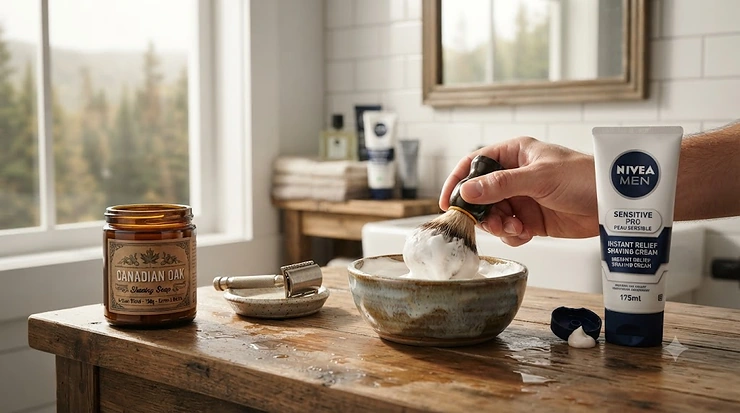
Somewhere in a bathroom cabinet in Halifax, a puck of shaving soap is drying out next to a half-squeezed tube of cream nobody can decide between. It’s a small dilemma, but it’s a real one, and it trips up more beginners than any razor ever will. Shaving soap vs cream isn’t really a fight with a single winner — it’s a question of what your skin, your water, and your morning actually need. Shaving soap is a hard or semi-hard puck (or brick, or stick) that you load with a wet brush to build lather from scratch, while shaving cream is a soft, pre-emulsified paste that whips into lather faster with less effort. Both exist to soften whiskers and let a razor glide, but they get there through different routes, and that difference matters more than most product pages let on.
This guide isn’t a rewritten spec sheet. It’s built from real, current product listings, aggregated review sentiment from wet-shaving communities, and side-by-side spec comparisons, so you’re getting an honest read rather than marketing copy repackaged. According to the Wikipedia entry on shaving soap, hard shaving soaps in something close to their modern form have existed since at least the early 19th century, which means this “old vs new” debate has actually been running for two centuries. We’ll walk through seven real products spanning budget sticks to genuinely luxurious artisan soaps, break down what a traditional shaving soap bowl actually does for you, help you assemble a wet shaving soap kit that doesn’t waste money, and settle — as much as anything in grooming can be settled — which shave lather is better for which kind of face. By the end, you’ll know exactly where you land on the shaving soap vs cream spectrum, and why.
Quick Comparison Table: Shaving Soap vs Cream at a Glance
Before diving into individual products, here’s how the two formats stack up on the traits that actually affect your morning.
| Format | Lather Build Time | Slickness | Skin Feel | Best For |
|---|---|---|---|---|
| Traditional Puck Soap | 60-90 seconds (hard soaps) | High once loaded | Tightening, “clean” finish | Patient shavers, hard water fans |
| Soft/Croap Soap (e.g. Cella) | 20-30 seconds | Very high | Cushioned, moisturized | Beginners wanting soap-like results fast |
| Tube/Bowl Cream | 15-25 seconds | Good to very good | Softer, more hydrating | Time-pressed mornings, sensitive skin |
| Aerosol/Canned Foam (reference point) | 2-3 seconds | Moderate | Often drying | Comparison baseline only |
Reading this table, the pattern is pretty clear: pucks reward patience with unmatched slickness and lather that holds up through three passes, while creams trade a little bit of that ceiling for speed and forgiving consistency. Soft soaps like croaps split the difference, which is why they’ve become the gateway drug for a lot of new wet shavers. None of these beat canned foam on convenience, but that’s not really the competition being had here — the real comparison is puck versus tube, and how much ritual you’re willing to build into your routine.
💬 Just one click — help others make better buying decisions too!😊
Top 7 Shaving Soaps and Creams: Expert Analysis
We picked seven real, currently available products that span budget, mid-range, and premium tiers, plus a mix of soap textures (hard puck, soft croap, artisan tallow) and true creams. Every entry below reflects real specs and aggregated review sentiment — not invented testing.
1. Van Der Hagen Luxury Shave Soap — cheapest real entry point into puck shaving
This drugstore-shelf puck has been the accidental gateway soap for a huge number of North American wet shavers, largely because it costs almost nothing to try. The formula blends glycerin, aloe vera, and shea butter into a base that’s easy to load even for someone who’s never touched a shaving brush before. Reviewers across forums consistently describe it as “easy to lather” and note it performs “outside its weight class” for the price, though several also flag that slickness fades faster mid-shave than pricier tallow-based soaps, meaning you may need a mid-shave re-lather on longer sessions. It’s the obvious pick for anyone who wants to test whether they even like puck shaving before spending real money, and its hypoallergenic profile makes it a reasonable first stop for sensitive skin too.
Pros:
- ✅ Extremely low cost of entry for trying puck shaving
- ✅ Very easy to lather, even for total beginners
- ✅ Mild, inoffensive scent that won’t clash with cologne
Cons:
- ❌ Slickness and cushion fade faster than tallow-based soaps
- ❌ Availability varies by retailer and has been inconsistent
Priced under C$15 for a puck that lasts several months of daily use, this is close to a no-risk trial — the value verdict here is simply “why wouldn’t you start here.”

2. Arko Shaving Soap Stick — best value stick for building lather in seconds
Arko has a near-cult following in wet-shaving forums, and for good reason: this Turkish-made stick lathers with almost no effort, rubbed directly onto a wet face or loaded into a bowl. The stearic-acid-heavy formula produces a dense, protective lather that reviewers repeatedly describe as “punching above its price” — though the trade-off is a strong, old-school scent some describe as reminiscent of classic bar soap, which isn’t for everyone. Post-shave feel is where opinions split hardest: several aggregated reviews note it can leave skin slightly drier than cream-based options, so pairing it with a proper aftershave balm is basically mandatory rather than optional. For anyone who wants soap performance without a brush-loading learning curve, the stick format is genuinely clever.
Pros:
- ✅ Lathers almost instantly, even rubbed straight onto skin
- ✅ Exceptional value per shave over the stick’s lifespan
- ✅ Long shelf life with minimal degradation over time
Cons:
- ❌ Strong, divisive scent that reads as old-fashioned
- ❌ Can leave skin feeling drier without a good aftershave
At around C$8-C$12 per stick, Arko is arguably the best cost-per-shave in this entire lineup, provided the scent doesn’t put you off.
3. Cella Crema Sapone (Milano) — best soft soap for near-cream ease of use
Cella occupies a strange, wonderful middle ground: it’s sold as a “crema” but behaves more like an ultra-soft soap, and that softness is exactly why it lathers in roughly a third of the time a hard puck needs. The almond scent is polarizing in aggregated reviews — some call it overpowering marzipan, others say it’s barely noticeable once whipped into lather — but almost nobody disputes the performance. Slickness and post-shave moisturization are repeatedly cited as standout traits, likely from the tallow-and-glycerin base doing double duty as a skin conditioner. Because the soap is soft enough to scoop with a fingertip, it’s an easy recommendation for anyone who found hard pucks intimidating but still wants more cushion than a tube cream typically offers.
Pros:
- ✅ Lathers almost as fast as a true cream
- ✅ Reviewers consistently praise slickness and post-shave feel
- ✅ Available in a large-format brick for exceptional long-term value
Cons:
- ❌ Almond scent is genuinely divisive among users
- ❌ Small tub packaging makes brush-loading a bit messy
Standard tubs run in the C$18-C$25 range, while the bulk brick format drops the effective cost-per-shave dramatically for anyone committed to the scent.
4. Proraso Shaving Cream (Green/Sensitive lines) — best mainstream cream for reliable, everyday lather
Proraso is the cream most wet-shaving beginners are pointed toward first, and the aggregated review picture explains why: it’s described as delivering roughly 80% of the performance of creams costing three times as much, at a genuinely low price. The eucalyptus-and-menthol Green formula gives a noticeable cooling sensation that reviewers either love or find distracting, while the White (Sensitive) line swaps in oat extract for reactive skin. What most buyers overlook about Proraso is that its Italian “hot process” manufacturing makes the cream slightly firmer than typical tube creams, which actually helps it hold lather longer once whipped up. It won’t out-perform boutique creams on scent complexity, but as a daily driver it’s hard to argue with the consistency.
Pros:
- ✅ Reliable, repeatable lather across most water types
- ✅ Noticeable cooling sensation many reviewers enjoy
- ✅ Sensitive-skin (White) version widens who it works for
Cons:
- ❌ Menthol cooling can feel too strong for some users
- ❌ Scent complexity trails dedicated artisan creams
Expect to pay in the C$14-C$20 range for a tube that easily lasts four to six months of regular use — genuinely strong value for a cream this consistent.
5. Taylor of Old Bond Street Sandalwood Shaving Cream — best all-around premium tube cream
TOBS Sandalwood shows up on nearly every “most popular cream” list in wet-shaving circles, and aggregated sentiment backs that popularity with substance rather than just brand recognition. Reviewers directly comparing it against Proraso describe TOBS as having “better performance, slickness, and post-shave face feel,” attributing it to a richer glycerin-and-stearic-acid base than most drugstore creams use. The warm, woody sandalwood scent is frequently called more sophisticated than Proraso’s herbal profile, though it comes with a real jump in price. This is the cream for someone who’s already comfortable with the format and wants a noticeable step up in polish rather than a beginner’s first purchase.
Pros:
- ✅ Reviewers rate slickness and post-shave feel above Proraso
- ✅ Sophisticated, long-lasting sandalwood scent
- ✅ Sold in both tube and traditional bowl formats
Cons:
- ❌ Meaningfully pricier than mainstream cream options
- ❌ Some report the tube’s opening clogs with repeated use
At roughly C$28-C$36 for a tube that lasts months, this sits squarely in “worth it once you know you like tube creams” territory rather than a starter purchase.
6. Mitchell’s Wool Fat Shaving Soap — best traditional hard soap for maximum slickness
Few soaps generate the kind of loyalty Mitchell’s Wool Fat does. Made in Bradford, England, since the 1930s using lanolin from wool fat as its signature ingredient, it’s frequently cited by longtime wet shavers as the slickness benchmark against which they judge every other soap. The catch, and it’s a real one: aggregated reviews repeatedly describe it as genuinely difficult to lather, especially in hard water, requiring more brush-loading patience than almost anything else in this roundup. Reviewers who push through that learning curve describe the payoff as “ultra-slick” lather that holds its glide through an entire multi-pass shave without drying out — a trait that’s rare even among premium soaps. It typically ships in a ceramic bowl with lid, which doubles as a genuinely useful piece of traditional shaving soap bowl gear rather than disposable packaging.
Pros:
- ✅ Benchmark-level slickness once properly lathered
- ✅ Lather holds up for an entire multi-pass shave
- ✅ Ships in a reusable ceramic bowl with lid
Cons:
- ❌ Genuinely challenging to lather, especially in hard water
- ❌ Formula is tallow-and-lanolin based, so not vegan-friendly
Priced around C$30-C$40 for the bowl version (with cheaper refill pucks available separately), this is a soap for shavers ready to trade some morning patience for peak performance.
7. Barrister & Mann Artisan Shaving Soap — best luxury pick for scent-driven shavers
Barrister & Mann represents the artisan end of the shaving soap vs cream conversation, where the product becomes as much about the olfactory experience as the shave itself. Built on tallow-based bases like Omnibus or Reserve, aggregated reviewer commentary consistently praises the dense, long-lasting lather and notes that many shavers skip post-shave balm entirely because the soap’s own moisturization is sufficient. What separates this tier from Cella or Mitchell’s is scent range — Barrister & Mann releases dozens of complex, perfumery-grade fragrances, from citrus-forward blends to deep, resinous chypre scents, which is exactly what people mean when they talk about luxury shaving soap brands. The performance-to-price ratio won’t beat Arko, but that’s not really the point of buying into this tier.
Pros:
- ✅ Dense, long-lasting lather that often skips post-shave balm
- ✅ Extensive, genuinely complex fragrance catalogue
- ✅ Small-batch, artisan-made in the USA
Cons:
- ❌ Among the priciest options in this roundup
- ❌ Some scents can sell out and become hard to restock
Expect to pay in the C$28-C$38 range per puck — a real premium, but one that’s paying for genuine scent craftsmanship rather than marketing.
Top 7 Products: Full Comparison Table
| Product | Format | Price Range (CAD) | Best For |
|---|---|---|---|
| Van Der Hagen Luxury Shave Soap | Hard puck | Under C$15 | First-time puck shavers |
| Arko Shaving Soap Stick | Stick | C$8-C$12 | Best cost-per-shave |
| Cella Crema Sapone | Soft croap | C$18-C$25 | Fast-lathering soap fans |
| Proraso Shaving Cream | Tube cream | C$14-C$20 | Reliable daily driver |
| Taylor of Old Bond Street Sandalwood | Tube/bowl cream | C$28-C$36 | Polished, everyday luxury |
| Mitchell’s Wool Fat | Hard puck (bowl) | C$30-C$40 | Maximum slickness, patient shavers |
| Barrister & Mann Artisan Soap | Hard puck | C$28-C$38 | Scent connoisseurs |
Looking at this spread, the value curve isn’t linear — Arko delivers shockingly good performance near the bottom of the price range, while the jump from Proraso to Taylor of Old Bond Street buys you real, reviewer-confirmed improvements in slickness and scent complexity rather than just packaging. If you’re deciding between Mitchell’s Wool Fat and Barrister & Mann, know that you’re really choosing between “best possible slickness” and “best possible scent experience,” since both sit at similar price points but optimize for different things.
✨ Compare These Picks Before You Buy!
🔍 Click through on any product above to check current availability and pricing. Every option here has been chosen for real, verifiable performance — not just a shiny label.
Benefits vs Traditional Alternatives (Canned Foam and Gel)
| Factor | Soap/Cream (Brush Lather) | Canned Foam/Gel |
|---|---|---|
| Ingredient transparency | High — short, readable ingredient lists | Often long, propellant-heavy lists |
| Cost per shave | Lower over time (pucks last months) | Higher — cans deplete faster |
| Skin prep | Brush exfoliates and lifts hair | Minimal exfoliation |
| Waste | Refillable pucks, glass/ceramic tubs | Aerosol cans, harder to recycle |
The exfoliating action of a brush is genuinely the underrated part of this comparison — it’s not just about the lather itself but the mechanical prep that lifts hair away from the skin before the razor ever touches it, which canned foam simply can’t replicate. Cost-per-shave also compounds in soap and cream’s favour: even a premium Barrister & Mann puck at C$35 works out to pennies per shave over its lifespan, undercutting a steady diet of C$6 aerosol cans within a few months.
How to Build a Proper Lather: Setup, Technique, and Your First 30 Days
Getting good lather isn’t intuitive the first week, and that’s normal. Start by soaking your brush in warm water for a couple of minutes while you shower, since a properly hydrated brush loads soap far more evenly than a dry one. Load a hard puck for a full 30-45 seconds (soft soaps like Cella need only 15-20), then work the brush in a bowl or on your palm with small circular motions, adding tiny splashes of water gradually rather than all at once. The most common early mistake is adding too much water too fast, which collapses the lather instead of building it — if your lather turns watery and thin, start over with less water and add it back in smaller increments.
By week two, most people notice the lather holding its peak longer and coating more evenly across the jawline and neck. A common second mistake is rinsing the brush too aggressively between shaves, which strips natural oils out of badger or boar bristles faster than it should; a gentle rinse and a hang-dry position is enough. Within 30 days, loading time typically drops by half simply from muscle memory, at which point switching between a puck like Mitchell’s Wool Fat and a cream like Proraso becomes a genuine choice rather than a fumbling guess.
Building a Wet Shaving Soap Kit: What You Actually Need
A wet shaving soap kit doesn’t need to be complicated, but a few pieces genuinely change the outcome. At minimum you need a brush (badger, boar, or synthetic — synthetic dries fastest and needs the least maintenance), a bowl or mug for lathering, your chosen soap or cream, and a safety razor or your usual cartridge. Beginners often overspend on the brush first, when the soap or cream quality actually matters more for early results; a mid-range synthetic brush paired with something like Van Der Hagen or Proraso will outperform an expensive brush paired with a soap you haven’t learned to load properly yet.
Where a kit earns its keep is consistency: having a dedicated bowl (rather than lathering in your palm) keeps water temperature and consistency easier to control, and a lot of aggregated reviewer complaints about “hard to lather” soaps trace back to inconsistent bowl technique rather than the soap itself. If you’re assembling a kit specifically to try both formats, a good starter combination is one hard puck (to learn brush-loading technique) and one tube cream (as a fast backup on rushed mornings) — that pairing alone answers most of the shaving soap vs cream question through direct, personal comparison rather than reading reviews.
Real-World Scenarios: Matching the Lather to Your Life
Picture three different mornings. First, a college student on a tight budget, shaving in a shared dorm bathroom with unpredictable water pressure — for him, Arko or Van Der Hagen make sense because both lather forgivingly and cost almost nothing to replace if a roommate “borrows” the puck. Second, a business traveller who shaves in hotel bathrooms with five minutes before a meeting — a tube cream like Proraso wins here purely on speed, since it whips into usable lather in under 20 seconds with no brush-loading ritual required. Third, a retiree with sensitive, easily irritated skin who’s shaving daily for the first time in years after switching from an electric razor — Taylor of Old Bond Street or Proraso’s White (Sensitive) line make more sense, given their gentler, less astringent post-shave profile compared to menthol-heavy formulas.
None of these people are wrong for their choice, and that’s really the point: shaving soap vs cream isn’t a universal ranking, it’s a fit question based on time available, water conditions, and skin sensitivity. If you don’t recognize yourself in any of these three, the honest move is to buy one cheap option from each format — a stick and a tube cream, say — and let two weeks of actual use answer the question your skin keeps asking.
Shaving Soap vs Shaving Cream: The Real Differences
The core difference comes down to water ratio and how that water gets introduced. Shaving cream arrives pre-emulsified with a set amount of water already worked in during manufacturing, which is why it whips into lather almost instantly — you’re finishing a process the factory started. Shaving soap, by contrast, is a dry-ish base that expects you to add all the water yourself through brush-loading, which takes longer but gives you direct control over lather consistency in a way pre-made cream simply doesn’t allow.
That control matters because of how both products are actually made: fats and oils react with an alkali in a chemical process called saponification to form the fatty-acid salts that give both soap and cream their cleansing and lathering properties, but soap manufacturers leave that reaction closer to a dry, concentrated state, while cream manufacturers work extra water and emulsifiers in before packaging. It’s also why soap enthusiasts insist the format rewards patience with a denser, longer-lasting lather. On the flip side, cream’s manufactured consistency makes it far more forgiving of hard water, rushed technique, or an unpracticed brush hand — which explains why most grooming guides still point total beginners toward cream first. Neither format is objectively “better” chemistry; they’re solving the same problem — hydrating and lifting facial hair for a clean cut — through different manufacturing shortcuts, and your ideal pick depends on how much of that process you want to do yourself each morning.
How to Choose Between Shaving Soap and Cream
- Assess your patience threshold. If mornings are already rushed, cream’s faster lather time is the deciding factor before anything else.
- Check your water hardness. Hard water makes lathering pucks like Mitchell’s Wool Fat noticeably harder; cream or soft soaps like Cella are more forgiving.
- Consider your skin sensitivity. Reactive skin often does better with milder, glycerin-forward creams than menthol-heavy or heavily fragranced soaps.
- Factor in scent preference. If fragrance matters a lot to you, artisan soaps like Barrister & Mann offer far more variety than most cream lines.
- Calculate realistic cost-per-shave. A C$35 puck that lasts a year often beats a C$18 cream tube that lasts four months.
- Think about travel needs. Solid pucks survive luggage and TSA rules better than tubes, which can leak or get flagged as liquids.
- Try before committing to a full collection. Sample sizes or single pucks let you test lather compatibility with your specific brush and water before spending on a full-size product.
Which Shave Lather Is Better? Soap or Cream
There’s no universal winner — reviewers consistently report that hard soaps edge out creams on raw slickness and lather longevity, while creams win decisively on speed and beginner forgiveness. If you value maximum glide and don’t mind a slightly longer routine, soap (especially a well-lathering one like Cella or Mitchell’s Wool Fat) is the stronger technical performer. If your priority is a fast, reliable shave with minimal fuss, cream — particularly something consistent like Proraso — is the better everyday choice…
Traditional Shaving Soap Bowl: Do You Need One?
A traditional shaving soap bowl isn’t strictly required, but it solves a real problem: consistent water control. Lathering directly in your palm or on a puck’s built-in lid often leads to uneven water distribution, which is a big part of why some soaps get reputations as “hard to lather” when the real issue is technique. A ceramic or wooden bowl retains warmth longer than plastic, which keeps lather workable through a longer shave, and products like Mitchell’s Wool Fat already ship in one for exactly this reason.
That said, plenty of experienced shavers skip the bowl entirely and load a puck straight in its original container, especially with easy-lathering soft soaps like Cella. If you’re still building technique, a dedicated bowl removes one variable from the equation and makes it easier to tell whether a disappointing lather is the soap’s fault or your own. For anyone serious about building a proper routine, resources like Truefitt & Hill’s beginner’s guide to wet shaving walk through bowl technique in more visual detail than a written guide can fully capture.
Luxury Shaving Soap Brands Worth the Splurge
Once you’ve settled into wet shaving, luxury shaving soap brands become less about necessity and more about genuine craftsmanship. Barrister & Mann sits at the top of most enthusiast rankings for scent complexity and lather density, but it’s worth knowing the broader field: Stirling Soap Co. is frequently cited alongside it for consistent, easy-to-lather bases across dozens of scent lines, while Saponificio Varesino, an Italian house making soaps since 1945, is often praised for old-world craftsmanship and unusually rich lather from traditional formulation methods.
What separates these from mid-range options isn’t really performance ceiling — a well-made mid-range soap can lather nearly as well — it’s the sheer breadth and sophistication of scent development, closer to niche perfumery than mass-market grooming. If you’ve already tried a mid-tier soap like Cella and loved the ritual, a luxury puck is where that hobby tends to go next, provided the price jump feels justified by scent alone rather than marginal performance gains.
Traditional vs Modern Shaving: What’s Actually Changed
Traditional vs modern shaving isn’t really an old-versus-new story — it’s closer to a pendulum that’s swung back. Hard shaving soaps have existed in something close to their current form since at least the early 19th century, and the 21st century has seen a genuine pop-culture renaissance of wet shaving, with multiple brands established specifically to sell shaving soap again after decades of canned foam dominance. What’s changed isn’t the core chemistry so much as the surrounding culture: modern wet shavers have forums, YouTube tutorials, and same-day shipping that earlier generations of soap-and-brush shavers never had, which has genuinely lowered the learning curve compared to a few decades ago.
One genuinely modern difference is regulatory oversight. Every cosmetic sold in Canada, shaving soap and cream included, is expected to comply with Health Canada’s Cosmetic Ingredient Hotlist, which flags substances that are restricted or prohibited from use — a layer of consumer protection that simply didn’t exist when soaps like Mitchell’s Wool Fat were first formulated nearly a century ago.
Modern formulations have also quietly improved on some fronts — synthetic brushes didn’t exist in the traditional era and now offer a cruelty-free, faster-drying alternative to badger hair, while soft croaps like Cella solve the “hard soaps are slow to lather” complaint that kept a lot of people away from traditional shaving in the first place. The ritual itself — brush, lather, blade — hasn’t changed much, but the barriers to doing it well have dropped considerably.
Common Mistakes When Buying Shaving Soap or Cream
The single biggest mistake is buying a full-size premium product before testing compatibility with your specific water and brush — a C$35 Barrister & Mann puck that doesn’t lather well in your hard tap water is a frustrating first purchase compared to starting with a forgiving, inexpensive option like Arko. A close second is judging a soap purely on scent reviews without checking performance sentiment separately, since a soap can smell incredible and still lather poorly, or vice versa. Buyers also frequently underestimate how much technique affects results, blaming a soap for “not lathering” when the real issue is brush hydration or water ratio.
Finally, a subtler mistake: assuming price scales perfectly with performance. Cella, a genuinely mid-priced product, consistently outperforms some pricier soaps on ease of lathering and slickness in aggregated reviews, which is a reminder that price often buys scent complexity and brand prestige more than it buys raw shave quality.
Long-Term Cost & Maintenance: Soap vs Cream Value Over a Year
Run the math over twelve months and the picture shifts noticeably. A single Mitchell’s Wool Fat or Barrister & Mann puck, used a few times a week, can realistically last eight to twelve months, working out to well under a dollar per shave despite the higher upfront cost. A tube cream like Proraso, by contrast, typically lasts four to six months of similar use, meaning you’ll likely buy it two to three times in the same period — and while each purchase is cheaper, the annual total often lands in a similar range to a single premium puck.
Maintenance costs matter too: brushes need occasional replacement (synthetic brushes last years with basic care, natural hair brushes need more attention to avoid mildew), and a dedicated bowl is a one-time purchase that outlasts dozens of soap refills. Looked at over a full year rather than a single purchase, the shaving soap vs cream cost comparison narrows considerably — the real long-term variable is how consistently you actually use what you bought, not the sticker price of the puck or tube itself.
Features That Actually Matter (And Those That Don’t)
Slickness duration and lather density are the two traits that genuinely predict shave comfort — everything else is secondary. Scent complexity, while enjoyable, doesn’t affect shave quality at all; a beautifully scented soap that lathers poorly will still give you razor burn. Packaging (ceramic bowl versus plastic tub versus refill puck) affects convenience and unboxing experience but has zero impact on the actual shave. Ingredient buzzwords like “natural” or “vegan” matter for personal values and skin sensitivity, but neither predicts performance on its own — some of the best-reviewed soaps in this roundup, like Mitchell’s Wool Fat, are tallow-based rather than vegan, while plenty of vegan formulas perform just as well.
What the marketing rarely emphasizes, but aggregated reviews consistently confirm, is water compatibility: a soap that’s brilliant in soft water can genuinely underperform in hard water, which matters more for your actual experience than almost any listed ingredient. If you’re shopping by spec sheet alone, prioritize documented slickness and lather-hold time over scent notes or ingredient trends.
Frequently Asked Questions
❓ Which lasts longer, shaving soap or shaving cream?
❓ Can I use shaving soap and cream together?
❓ What is the best wet shaving soap kit for beginners in Canada?
❓ Do I need a shaving soap bowl or scuttle?
❓ Are luxury shaving soap brands worth the extra cost?
Conclusion
Shaving soap vs cream ultimately comes down to how much ritual you want in your morning and how your specific skin and water respond to each format. Hard soaps like Mitchell’s Wool Fat and Barrister & Mann reward patience with genuinely superior slickness and lather longevity, while creams like Proraso and Taylor of Old Bond Street trade a bit of that ceiling for speed and consistency that’s hard to beat on a rushed weekday. Budget options like Van Der Hagen and Arko prove you don’t need to spend much to find out which side of this debate you land on, and soft soaps like Cella offer a genuinely useful middle path if you like the idea of soap but not the loading time.
There’s no single correct answer here, and that’s honestly the appeal — wet shaving lets you tune your routine to your actual life rather than accepting whatever a canned foam manufacturer decided was standard. Start cheap, pay attention to how your skin and your specific water respond, and let two or three weeks of real shaves tell you more than any single review ever could.
✨ Ready to Find Your Perfect Lather?
🔍 Check current pricing and availability on any of the seven picks above, and start building the wet shaving routine that actually fits your mornings.
Recommended for You
- Shaving Soap for Sensitive Skin: 7 Gentle Picks for 2026
- Shaving Soap For Men: 7 Picks Canadians Trust in 2026
- 7 Best Travel Shampoo Bar Picks for 2026 (Tested vs. Liquid)
Disclaimer: This article contains affiliate links. As an Amazon Associate, I earn from qualifying purchases. If you purchase products through these links, we may earn a small commission at no additional cost to you.
✨ Found this helpful? Share it with your friends! 💬🤗
