In This Article
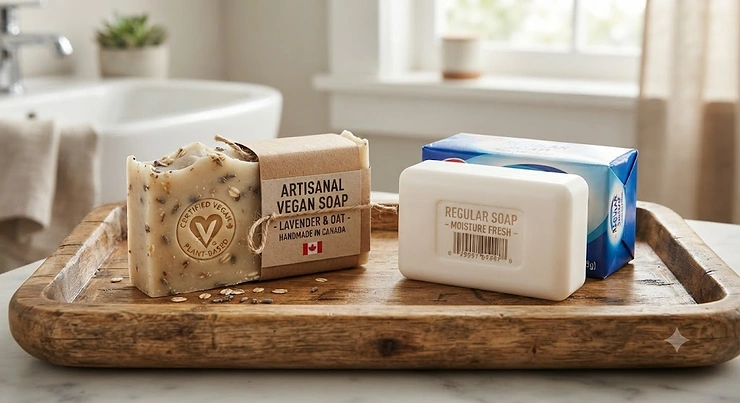
Stand in front of any drugstore soap aisle in Canada and you’ll see the word “natural” slapped on roughly every third bar. It means almost nothing. What actually separates a bar you can trust from one that’s quietly made with rendered animal fat is a much narrower, much more interesting question — and it’s the one this guide answers. The short version of certified vegan soap vs regular soap comes down to two things: what’s in the bar, and who verified that claim. Certified vegan soap is formulated entirely from plant, mineral, or synthetic-but-non-animal ingredients and carries third-party verification confirming no animal-derived material or animal testing was involved anywhere in the supply chain. Regular soap makes no such promise — and often can’t, because a huge share of mass-market bars still lean on animal by-products for texture and hardness.

That gap matters more than most shoppers realize. A “natural” label on a soap bar is a marketing choice, not a regulated claim, while “certified vegan” involves an actual audit trail. Health Canada regulates cosmetic safety and requires manufacturers to notify the department of what’s inside every product sold here, but it does not verify ethical claims like “vegan” or “cruelty-free” — that job falls to independent certifying bodies. Understanding how those certifications actually work is the first step to shopping smarter, and it’s exactly where most soap-buying guides stop short.
In this guide, you’ll get a plain-English breakdown of what makes soap vegan (and what doesn’t), a look at the certification labels actually worth trusting in Canada, seven real bars you can buy right now across budget, mid-range, and premium tiers, and a practical framework for deciding whether the switch is worth it for your skin and your wallet. No invented reviews, no inflated claims — just what the spec sheets, the ingredient panels, and genuine aggregated reviewer sentiment actually say.
Quick Comparison: Certified Vegan Soap vs Regular Soap
| Factor | Certified Vegan Soap | Regular (Conventional) Soap | Best For |
|---|---|---|---|
| Core ingredients | Plant oils (coconut, olive, palm, shea) | Often includes sodium tallowate (rendered beef fat) | Anyone avoiding animal-derived inputs |
| Verification | Third-party audited (Leaping Bunny, Certified Vegan logo, EWG Verified) | Usually self-declared, unaudited | Shoppers who don’t want to take a brand’s word for it |
| Typical texture | Ranges from soft castile lather to firm cold-process bars | Often firmer, longer-lasting bars due to tallow’s hardness | Depends on personal preference |
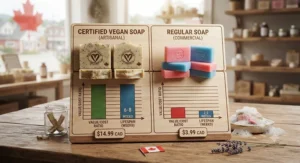
| Price in Canada | Roughly C$4–C$13 per bar depending on brand and size | Roughly C$1–C$6 per bar for mass-market brands | Budget shoppers may still find affordable vegan options |
| Supply chain concerns | Palm oil sourcing and fair trade practices still worth checking | Tied to the meat-rendering industry’s byproduct stream | Eco-conscious buyers weighing both angles |
Looking at the table above, the price gap between certified vegan soap and regular drugstore bars is smaller than most people assume — brands like Kiss My Face Pure Olive Oil Bar Soap and The Unscented Company Soap Bar land in the same price bracket as big-box tallow-based bars. Where vegan soap tends to cost more is at the specialty end, where fair-trade sourcing, small-batch production, and third-party audits genuinely add to overhead. If you’re buying based on ethics alone, certification is non-negotiable; if you’re buying based on skin feel, the honest answer is that both categories include gentle options and harsh ones, so ingredient lists matter more than the vegan label by itself.
💬 Just one click — help others make better buying decisions too!😊
Top 7 Certified Vegan Soaps: Expert Analysis
Every product below is a real, currently available soap with a genuinely vegan ingredient list, chosen to span budget, mid-range, and premium price points, plus a dedicated Canadian-made option. Price ranges reflect research at the time of writing — always check current pricing before buying, since Amazon pricing shifts often.
1. Dr. Bronner’s Pure-Castile Bar Soap — the multi-use classic with organic certification
Dr. Bronner’s Pure-Castile Bar Soap built its reputation on doing one thing honestly: saponified organic plant oils, nothing else pretending to be something it’s not. The bar is made with Regenerative Organic Certified coconut, olive, hemp, and jojoba oils, with no synthetic detergents, dyes, or chelating agents added. That matters practically — because it’s a true soap rather than a synthetic detergent bar, it biodegrades cleanly and works as a body wash, shampoo bar, and even a general household cleanser in a pinch. Based on the spec comparison with other castile-style bars, this one earns its reputation less through gimmicks and more through a genuinely short, verifiable ingredient list. It’s a strong fit for buyers who want one product doing several jobs, campers and minimalist travelers packing light, and anyone who wants organic certification without hunting through niche skincare brands. Reviewers consistently report that the lather is thinner than a typical commercial bar, and that in hard-water regions the soap can leave a faint film unless rinsed thoroughly — a known trait of true soap rather than a flaw specific to this brand. A common complaint in user reviews is that the unscented “Baby” variant is almost too plain for people expecting a spa-like experience, while fans of the peppermint and citrus scents tend to be enthusiastic repeat buyers.
Pros:
- ✅ Regenerative Organic Certified oils, third-party verified
- ✅ Works as body wash, shampoo bar, and household cleaner
- ✅ Packaged in post-consumer recycled paper, minimal plastic
Cons:
- ❌ Can leave soap-scum residue in hard-water areas
- ❌ Thinner lather than syndet or tallow-based bars
Expect to pay somewhere in the C$4-C$8 range for a single 5oz bar, with multi-packs bringing the per-bar cost down further — solid value for a certified-organic, multi-use bar.
2. Kiss My Face Pure Olive Oil Bar Soap — best minimalist formula for sensitive skin
Kiss My Face Pure Olive Oil Bar Soap strips the formula down to almost nothing: olive oil, water, and sea salt, full stop. That 86% olive oil concentration is the whole story here — olive oil soap has centuries of use (Mediterranean castile traditions predate most “clean beauty” marketing by hundreds of years) precisely because it’s gentle enough for reactive skin while still cleansing effectively. What most buyers overlook about this bar is that fewer ingredients generally means fewer potential irritants, which is exactly why dermatology-adjacent recommendations for eczema-prone or fragrance-sensitive skin so often point toward simple olive-oil-based bars like this one. It’s a natural fit for anyone with sensitive or reactive skin, budget-conscious shoppers who don’t want to pay a premium for a long ingredient list of “extras,” and people managing conditions like mild eczema who’ve been told to avoid synthetic fragrance and dye. Aggregated reviewer sentiment skews positive on the moisturizing feel, with many noting it doesn’t leave skin tight the way stripped detergent bars can. A recurring theme in less favorable reviews is that the bar softens and turns mushy faster than firmer bars if left sitting in water between uses — a predictable outcome of a formula without hardening additives, not a manufacturing defect.
Pros:
- ✅ Just three ingredients, ideal for sensitive skin
- ✅ Certified vegan and fragrance-free option available
- ✅ One of the most budget-friendly picks on this list
Cons:
- ❌ Softens quickly if not stored on a draining dish
- ❌ Minimal scent may feel too plain for some users
Priced around C$4-C$7 for a single bar, or less per-bar when bought in a multi-pack, it’s one of the most accessible entry points into certified vegan soap.
3. Nubian Heritage African Black Soap Bar — best for oily or blemish-prone skin
Nubian Heritage African Black Soap Bar draws on a genuinely traditional West African formula built around palm ash, shea butter, oats, aloe, and tamarind extract. Here’s what to weigh with this one: palm ash acts as a mild natural exfoliant and has long been used in West African skincare traditions specifically for oily, blemish-prone, and irritation-prone skin, while the shea butter offsets the potential dryness that exfoliating ingredients can cause. The spec sheet won’t tell you this, but user reports suggest the bar can look visually inconsistent — darker in some batches, more crumbly in others — which is a natural consequence of handcrafted, small-batch production rather than a quality issue. This bar is best suited to buyers dealing with oily or combination skin, anyone drawn to traditional, minimally processed formulations over synthetic alternatives, and people who don’t mind a stronger, earthier natural scent in exchange for the exfoliating benefit. Reviewers consistently note a noticeable difference in how their skin feels after switching from synthetic detergent bars, particularly around reduced breakouts, though — as with any natural exfoliant — some with very dry or sensitive skin report it feeling slightly stripping if used daily.
Pros:
- ✅ Traditional palm-ash formula suited to oily, blemish-prone skin
- ✅ Shea butter offsets dryness from natural exfoliation
- ✅ No synthetic fragrance in the base formula
Cons:
- ❌ Visual consistency varies batch to batch
- ❌ Stronger earthy scent isn’t for everyone
Expect a mid-range price around C$7-C$10 per bar, reflecting the more involved traditional production process compared to simple castile bars.
4. Alaffia Authentic African Black Soap, Triple Milled Charcoal Reishi — best for a detox-style deep clean
Alaffia Authentic African Black Soap, Triple Milled Charcoal Reishi takes the traditional black soap concept and refines it through triple milling — a process that compresses and re-processes the soap multiple times for a smoother, longer-lasting bar than raw, unmilled black soap. Based on the spec comparison, triple milling is the practical difference-maker here: it’s the reason this bar holds its shape and lasts through more washes than the crumblier traditional format. The addition of activated charcoal and reishi mushroom extract targets oil absorption and antioxidant support respectively, though it’s worth being honest that charcoal’s oil-drawing effect is well-documented while reishi’s topical antioxidant benefit in a rinse-off product is more modest than shea butter’s cocoa-adjacent siblings sometimes market it as. This bar suits buyers with oily or combination skin looking for a longer-lasting bar than raw black soap, people interested in fair-trade sourced shea butter (Alaffia’s cooperative model in West Africa is a genuine differentiator worth noting), and anyone who prefers a lightly scented bar over a completely fragrance-free one. A common theme in aggregated reviews is appreciation for the fair-trade sourcing story alongside solid day-to-day performance, though a fair number of reviewers flag that this bar, like most palm-oil-containing soaps, isn’t the right pick for buyers specifically trying to avoid palm ingredients for environmental reasons.
Pros:
- ✅ Triple-milled for a longer-lasting bar than raw black soap
- ✅ Fair-trade shea butter sourced through women-led cooperatives
- ✅ Charcoal helps manage oily and combination skin
Cons:
- ❌ Contains palm-derived ingredients, a concern for some eco-conscious buyers
- ❌ Lightly fragranced, not a fragrance-free option
Pricing typically sits around C$6-C$9 per bar, competitive with other specialty African black soap formulations.
5. ATTITUDE Super Leaves Body Bar Soap — best Canadian-made, EWG Verified pick
ATTITUDE Super Leaves Body Bar Soap comes from a Montreal-founded company that has built its entire brand identity around EWG Verification, PETA-certified vegan status, and ECOLOGO certification — three separate third-party audits stacked on one bar. What most buyers overlook about this pick is what EWG Verified actually requires: every single ingredient screened against the Environmental Working Group’s ingredient database, not just a marketing claim about “natural” sourcing. That’s a meaningfully higher bar than most soap companies clear voluntarily. Formulated with botanical extracts like matcha and bergamot, this bar suits Canadians who specifically want to support a domestic manufacturer, buyers who prioritize verified clean-ingredient formulations over natural-sounding marketing language, and anyone building a fully cruelty-free bathroom routine who wants one brand’s ecosystem to shop from consistently, since ATTITUDE also makes matching dish soap, hand soap, and shampoo lines. Reviewers consistently note the pleasant, non-overpowering scent profile and the fact that the packaging (FSC-certified cardboard) reduces plastic waste noticeably compared to bottled body wash. The tradeoff most commonly mentioned is size: at 4oz, the bar is smaller than several competitors at a similar price point, which affects the cost-per-use math discussed later in this guide.
Pros:
- ✅ Triple certified: EWG Verified, PETA vegan, ECOLOGO
- ✅ Manufactured in Montreal, Quebec
- ✅ Plastic-reduced, FSC-certified cardboard packaging
Cons:
- ❌ Smaller 4oz bar size relative to the price
- ❌ Narrower scent lineup than larger competitors
Typical pricing runs around C$8-C$11 per bar, positioning it as a mid-range option with a strong certification-to-price ratio.

6. The Unscented Company Soap Bar — best fragrance-free budget pick
The Unscented Company Soap Bar is built around a straightforward premise: strip out fragrance and unnecessary additives entirely, and keep the price low. It’s a Canadian brand, and the “unscented” positioning isn’t an afterthought — it’s the whole design philosophy, aimed squarely at buyers managing fragrance sensitivities, allergies, or skin conditions where added scent is a genuine irritant rather than a nice-to-have. Here’s what to weigh: a fragrance-free formula generally means fewer of the allergen categories Health Canada has been moving to require disclosure on cosmetic labels, so buyers with a documented fragrance sensitivity get a real practical benefit, not just a marketing angle. This bar is the right call for anyone with diagnosed fragrance allergies or sensitive skin conditions, budget-focused Canadian shoppers who still want a certified vegan, cruelty-free option, and households buying in bulk for multiple family members where a lower per-bar cost adds up. Aggregated reviewer sentiment leans heavily toward appreciation for the simplicity and the price point, with sensitive-skin users specifically calling out the absence of a post-wash reaction they’d experienced with scented alternatives. The most common critique is that the unscented, no-frills format feels utilitarian rather than indulgent — which, to be fair, is exactly what it’s designed to be.
Pros:
- ✅ Fully fragrance-free, ideal for sensitive or allergy-prone skin
- ✅ One of the most affordable certified vegan options available
- ✅ Canadian-made and allergen-focused formulation
Cons:
- ❌ No scent variety for buyers who want a fragranced bar
- ❌ Basic packaging compared to premium competitors
Expect pricing around C$4-C$6 per bar, making it one of the best value-for-money picks on this list.
7. Rocky Mountain Soap Co. Cold-Process Bar Soap — best premium, small-batch Canadian pick
Rocky Mountain Soap Co. Cold-Process Bar Soap comes from a Canmore, Alberta company that has been hand-crafting soap for roughly 25 years, and the production method is the real story here. Cold-process soapmaking retains more of the natural glycerin generated during saponification than mass commercial processes, where glycerin is frequently extracted and sold separately to other industries (it’s a valuable byproduct on its own). Based on the spec comparison with mass-produced bars, that retained glycerin is a genuine, measurable reason cold-process bars tend to feel less drying — it’s not just an artisanal marketing story. This bar is the strongest fit for buyers who want a genuinely small-batch, handmade product with a wide range of natural scent options, anyone willing to pay a premium for a Canadian company with physical storefronts and direct accountability rather than a purely online brand, and gift-buyers looking for something that reads as considered rather than generic. One important honesty note: not every scent or line in Rocky Mountain Soap Co.’s broader catalogue is vegan — some formulations include honey or beeswax — so buyers specifically shopping for the certified vegan cold-process bars should double-check the individual product listing rather than assuming the whole brand qualifies. Reviewers consistently praise the scent range and the moisturizing feel of the cold-process format, with the main pushback being price relative to mass-market alternatives.
Pros:
- ✅ Cold-process method retains natural skin-softening glycerin
- ✅ Small-batch, Canadian handmade production in Alberta
- ✅ Wide range of genuinely distinct natural scents
Cons:
- ❌ Premium pricing compared to mass-produced bars
- ❌ Not every product line in the brand’s catalogue is vegan — verify per bar
Pricing typically lands around C$9-C$13 per bar, reflecting the small-batch production and the brand’s storefront overhead.
How to Switch to Certified Vegan Soap Without Wrecking Your Skin
Switching soap types is not a zero-risk swap, and treating it like one is the most common mistake first-time buyers make. In the first week, expect a short adjustment period — true soap bars (like castile-style formulas) behave differently on skin than syndet bars or tallow-based soaps, and your skin’s oil production takes a few days to recalibrate to a new cleansing chemistry. Store any bar soap, vegan or not, on a well-draining dish rather than a flat surface; this single habit extends bar life significantly, since soap that sits in standing water softens and dissolves faster regardless of formula. For the first thirty days, patch-test a new bar on a small area (inner forearm works well) before committing to full facial use, especially with exfoliating formulas like African black soap. A common early mistake is assuming “vegan” automatically means “gentle” — high-olive-oil castile bars and simple three-ingredient formulas tend to be genuinely mild, but exfoliating or charcoal-based vegan bars can be just as potentially drying as their non-vegan counterparts if overused on already-dry skin. Finally, don’t judge lather thickness against your old bar in the first few uses; true soap generally produces a thinner, looser lather than detergent-based bars, and that’s a formula characteristic, not a sign the product isn’t working.
✨ Ready to make the switch? Compare current prices on today’s picks and start building your cruelty-free routine.
Real-World Scenarios: Who Actually Needs Certified Vegan Soap
The budget-conscious student. If you’re a college student sharing a bathroom and buying soap on a tight monthly budget, The Unscented Company Soap Bar or Kiss My Face Pure Olive Oil Bar Soap solve the problem without stretching the budget — both sit at the low end of the price range while still carrying genuine vegan certification, so there’s no meaningful tradeoff for going ethical here.
The sensitive-skin household. Families managing eczema, fragrance allergies, or generally reactive skin should lean toward fragrance-free, short-ingredient-list options. The Unscented Company Soap Bar and Dr. Bronner’s Pure-Castile Bar Soap (unscented “Baby” variant) both minimize the allergen categories most likely to trigger a reaction, which matters more for this group than any other feature on the spec sheet.
The oily-skin commuter. If you’re dealing with oily or acne-prone skin and want something that actually addresses the problem rather than just being “natural,” Nubian Heritage African Black Soap Bar or Alaffia Authentic African Black Soap, Triple Milled Charcoal Reishi bring genuine exfoliating and oil-absorbing properties to the table, backed by ingredients (palm ash, charcoal) with a real functional purpose rather than just marketing appeal.
Common Soap-Aisle Problems, Solved
Problem: your vegan soap dissolves too fast. This usually comes down to storage, not formula — true soap without synthetic hardening agents (like Kiss My Face Pure Olive Oil Bar Soap) softens quickly in standing water. Solution: switch to a draining soap dish and cut bars in half to reduce surface contact with moisture between uses.
Problem: you can’t tell if a “natural” bar is actually vegan. Ingredient lists using Latin botanical names can obscure animal-derived inputs. Solution: scan for sodium tallowate, lanolin, milk derivatives, honey, or beeswax on the label, or default to brands carrying independent certification like Leaping Bunny or the Certified Vegan trademark, discussed in detail below.
Problem: your skin feels tight after switching to a vegan bar. This is often an ingredient issue, not a “vegan soap is drying” issue — some plant-oil formulas skew more cleansing than moisturizing. Solution: look for higher oil-content formulas like Kiss My Face Pure Olive Oil Bar Soap (86% olive oil) or cold-process bars like Rocky Mountain Soap Co. Cold-Process Bar Soap that retain more natural glycerin.
Problem: you’re unsure whether palm oil in a vegan soap is a dealbreaker. Palm oil is technically vegan (it’s plant-derived) but carries well-documented deforestation and habitat-loss concerns depending on sourcing. Solution: if this matters to you specifically, look for palm-free formulas or brands disclosing certified sustainable palm sourcing, and don’t assume “vegan” automatically means “environmentally ideal” — they’re separate questions.
What Is Certified Vegan Soap? What Makes Soap Vegan, Explained
Certified vegan soap is soap formulated without any animal-derived ingredients — no tallow, lanolin, honey, beeswax, milk, or collagen — and independently verified by a third-party body rather than simply self-declared by the manufacturer. What makes soap vegan comes down to the fat or oil base used in saponification: traditional bar soap has historically relied on animal fats like tallow (rendered beef fat) or lard because they’re cheap, widely available as a byproduct of the meat industry, and produce a firm, long-lasting bar. Vegan soap swaps that base for plant oils — coconut, palm, olive, shea, or hemp — which requires reformulating the saponification ratios since plant oils behave differently than animal fats during the chemical reaction that turns fat into soap. The word “vegan” on packaging alone isn’t regulated the way food allergen labels are in Canada, which is exactly why certification matters: a brand can claim “plant-based” while quietly including a minor animal-derived additive, whereas certified vegan status requires the entire formula, not just the headline ingredients, to pass review.
Vegan Certification Labels in Canada: Reading the Logos
Not every logo on a soap wrapper carries equal weight, and Canadian shoppers specifically need to know which marks actually involve independent verification. The Certified Vegan trademark (a “V” inside a sunflower, administered by Vegan Action in the US but widely used on products sold in Canada) confirms a product contains no animal ingredients and wasn’t tested on animals, based on a manufacturer application reviewed against a documented standard. Leaping Bunny, covered in detail in the next section, confirms cruelty-free status specifically — not veganism — so a Leaping Bunny bar can still contain honey or lanolin unless it’s separately marked vegan. EWG Verified, which several ATTITUDE products carry, screens the full ingredient list against the Environmental Working Group’s safety database and is a meaningfully different (and often more rigorous) standard than a simple vegan claim. PETA’s “Vegan and Cruelty-Free” logo is another common mark, based on a company-submitted statement of compliance rather than an independent lab audit, which makes it somewhat lighter-weight than Leaping Bunny’s supplier-monitoring requirement. The practical takeaway: a bar carrying two or three of these marks stacked together (as several products in this guide do) offers meaningfully more assurance than a single unverified “vegan-friendly” claim printed by the manufacturer itself.
Leaping Bunny Certification: What It Means (and Doesn’t)
Leaping Bunny is operated by the Coalition for Consumer Information on Cosmetics, a group formed in 1996 by eight national animal protection organizations specifically to standardize cruelty-free claims after companies had started designing their own unregulated bunny logos. The Leaping Bunny program, run under Cruelty Free International, requires brands to commit to a fixed cut-off date after which neither the brand nor any of its suppliers may conduct or commission animal testing, to maintain a supplier monitoring system verifying every ingredient supplier’s compliance, and to submit to independent audits and annual renewal rather than a one-time certification. Here’s the nuance most soap shoppers miss: Leaping Bunny certifies cruelty-free status, not vegan status. A soap could be genuinely Leaping Bunny certified while still containing honey, beeswax, or lanolin, none of which involve animal testing but all of which come from animals. For a soap to check both boxes — no animal testing and no animal ingredients — you generally want to see Leaping Bunny paired with a separate vegan certification or an explicitly vegan ingredient list, which is exactly the combination products like Dr. Bronner’s Pure-Castile Bar Soap and Kiss My Face Pure Olive Oil Bar Soap are built around.
It’s also worth noting that Canada’s regulatory landscape shifted meaningfully in this area: as of December 2023, Canada legally banned cosmetic animal testing outright through an amendment to the Food and Drugs Act, meaning companies can no longer test cosmetics on animals or sell products relying on new animal-testing data to establish safety. That’s a meaningful floor for the entire Canadian market, but it’s a testing ban, not an ingredient ban — a soap can be legally sold in Canada post-2023 without being vegan, since the law addresses testing methodology rather than formulation. Third-party vegan certification still does work the testing ban doesn’t cover.
Animal By-Products in Soap: Tallow, Lanolin, and What Tallow-Free Formulas Skip
Sodium tallowate is the single most common animal-derived ingredient hiding in plain sight on soap labels, and it’s exactly what it sounds like: the sodium salt produced when beef or mutton tallow (rendered animal fat) undergoes saponification. It shows up in mass-market bars because tallow is inexpensive, widely available as a meat-industry byproduct, and produces a firm, long-lasting bar with a rich, stable lather — which is precisely why it became the historical default long before “vegan” was a mainstream shopping consideration. Tallow-free formulas swap this base for plant oils entirely, which is functionally what every product in this guide’s product roundup does. Beyond tallow, a handful of other animal-derived ingredients show up in soap formulations worth watching for: lanolin (extracted from sheep’s wool, used for its moisturizing properties), milk or goat’s milk (added for a creamy lather and marketed heavily in specialty soap lines), honey and beeswax (common in “natural” artisanal soaps, including some lines from otherwise excellent Canadian handmade brands), and occasionally glycerin sourced from animal fat rather than plant oils, since glycerin itself is chemically identical regardless of source but its origin determines vegan status. The practical rule for tallow-free, fully vegan shopping: scan the ingredient list for “tallowate,” “lanolin,” “lac” (milk-derived), “mel” (honey), or “cera alba” (beeswax) in the Latin/INCI naming convention, and when in doubt, default to a certified product rather than trying to parse Latin ingredient names in a store aisle.
How to Choose Certified Vegan Soap: 7 Expert Criteria
- Check for third-party certification, not just the word “vegan.” A stacked certification (Leaping Bunny plus a vegan trademark, or EWG Verified plus PETA vegan) offers stronger assurance than a single self-declared claim.
- Match the oil base to your skin type. High-olive-oil formulas like Kiss My Face Pure Olive Oil Bar Soap suit dry or sensitive skin, while charcoal or black-soap formulas suit oily or blemish-prone skin.
- Decide how much you care about fragrance. Fragrance-free options like The Unscented Company Soap Bar meaningfully reduce irritation risk for reactive skin, while fragranced bars offer a more indulgent experience for skin that tolerates scent well.
- Weigh palm oil sourcing if sustainability matters to you. Vegan and sustainably sourced are two different questions — check for fair-trade or certified sustainable palm claims if this is a priority.
- Consider production scale and price tolerance. Mass-produced options like Dr. Bronner’s Pure-Castile Bar Soap cost less per use; small-batch cold-process bars like Rocky Mountain Soap Co. Cold-Process Bar Soap cost more but retain more natural glycerin.
- Support Canadian manufacturing if that’s a priority. ATTITUDE Super Leaves Body Bar Soap, The Unscented Company Soap Bar, and Rocky Mountain Soap Co. Cold-Process Bar Soap are all genuinely Canadian-made.
- Patch-test before committing to full-face or daily use, especially with exfoliating or heavily fragranced formulas, regardless of how many certification logos the bar carries.
Common Mistakes When Buying Vegan Soap in Canada
The most frequent mistake is assuming “cruelty-free” and “vegan” are interchangeable — as covered above, Leaping Bunny certifies testing practices, not ingredients, so a cruelty-free bar can still contain honey or lanolin. A second common error is judging a vegan bar’s quality against a completely different product category; comparing a true castile soap’s thin lather unfavorably against a syndet detergent bar’s thick foam is comparing two different chemistries, not a fair quality assessment. Third, buyers frequently overlook that a brand’s overall reputation doesn’t guarantee every individual product line is vegan — as noted with Rocky Mountain Soap Co. Cold-Process Bar Soap, some scent lines within an otherwise ethical company’s catalogue include honey or beeswax, so checking the specific product listing matters more than trusting the brand name alone. Finally, many shoppers skip the patch-test step specifically because a product is marketed as “natural” or “gentle,” when in reality natural exfoliants like palm ash or activated charcoal can be just as potentially irritating to already-compromised skin as any synthetic alternative.
Certified Vegan Soap vs Regular Soap: The Real Differences
The functional gap between certified vegan soap and regular soap is smaller than the marketing gap. Both categories span a genuine range from gentle to potentially irritating, and both can produce a satisfying lather depending on formulation choices rather than the presence or absence of animal ingredients specifically. Where the categories genuinely diverge is in supply chain transparency: certified vegan products come with a documented audit trail, while regular soap’s ingredient sourcing — particularly around tallow, a byproduct of the meat industry — typically isn’t disclosed beyond the required INCI ingredient list on the label. There’s also a durability difference worth noting honestly: tallow’s natural hardness historically made regular soap bars last somewhat longer per gram than delicate castile-style vegan bars, though modern formulation techniques (like the triple-milling used in Alaffia Authentic African Black Soap, Triple Milled Charcoal Reishi, or the cold-process method behind Rocky Mountain Soap Co. Cold-Process Bar Soap) have significantly closed that gap. For buyers whose primary motivation is animal welfare or environmental footprint linked to livestock rendering, the choice is straightforward. For buyers primarily chasing skin feel or lather thickness, ingredient specifics matter more than the vegan label itself.
Long-Term Cost & Value: Is Vegan Soap Worth the Premium?
Cost-per-use is the metric that actually matters here, not sticker price. A The Unscented Company Soap Bar at roughly C$5 per bar, used daily by one person, works out to a few cents per wash over a typical 4-6 week bar lifespan — genuinely comparable to budget mass-market tallow soap. At the premium end, Rocky Mountain Soap Co. Cold-Process Bar Soap at roughly C$11 per bar costs more upfront, but cold-process bars with retained glycerin often last longer per gram than stripped detergent bars because they don’t dissolve as quickly in typical use, partially offsetting the higher entry price. The real long-term value consideration isn’t really the soap bar cost at all — it’s what you’re not buying alongside it. Fragrance-free, minimal-ingredient vegan bars like Kiss My Face Pure Olive Oil Bar Soap reduce the odds of needing a separate moisturizer to counteract stripping, which is a real (if hard to quantify precisely) offsetting saving for buyers with dry or reactive skin who’d otherwise be layering products to compensate for a harsher primary cleanser.
| Product | Price Range (CAD) | Approx. Bar Life | Best For |
|---|---|---|---|
| Kiss My Face Pure Olive Oil Bar Soap | C$4–C$7 | 3–4 weeks | Budget, sensitive skin |
| The Unscented Company Soap Bar | C$4–C$6 | 3–4 weeks | Budget, fragrance-free |
| Nubian Heritage African Black Soap Bar | C$7–C$10 | 4–5 weeks | Oily/blemish-prone skin |
| ATTITUDE Super Leaves Body Bar Soap | C$8–C$11 | 3–4 weeks | Canadian-made, EWG Verified |
| Rocky Mountain Soap Co. Cold-Process Bar Soap | C$9–C$13 | 5–6 weeks | Premium, moisturizing |
Looking at the value breakdown above, the premium Rocky Mountain Soap Co. Cold-Process Bar Soap narrows the cost-per-use gap with budget picks thanks to its longer bar life, while The Unscented Company Soap Bar remains the strongest pure-budget option for households buying in bulk. Buyers prioritizing oily-skin management should note that Nubian Heritage African Black Soap Bar sits in the middle of both price and longevity, a reasonable trade-off for its targeted exfoliating benefit.
📌 Compare current prices before you buy — availability and pricing shift often.
Features That Actually Matter (And Marketing Claims That Don’t)
Genuinely meaningful features to look for: independent third-party certification (not a self-declared vegan claim), a short, recognizable ingredient list where you can identify the primary oil base, and formulation type matched to your skin’s actual needs (exfoliating for oily skin, high-oil-content for dry skin). Marketing language that sounds meaningful but often isn’t: “natural” (unregulated and essentially meaningless without a certifying body behind it), “artisanal” or “handcrafted” (describes production scale, not ingredient ethics — plenty of handcrafted soap contains tallow or honey), and “detox” claims attached to charcoal formulas, which draw out surface oil effectively but shouldn’t be read as a deeper physiological detoxification claim, since skin doesn’t “detox” through a rinse-off product in the way that language implies. The spec sheet won’t tell you this directly, but user reports across multiple vegan soap brands consistently suggest that ingredient-list literacy — knowing to look for “sodium tallowate” or “lac” rather than trusting front-of-package language — is the single most useful skill a shopper can develop in this category, more valuable than any individual certification logo.
Safety, Sensitive Skin & Canadian Regulations Guide
All cosmetics sold in Canada, vegan or not, fall under Health Canada’s Cosmetic Regulations, which require manufacturers and importers to notify Health Canada of a product’s full ingredient list before it can legally be sold, and prohibit any ingredient that “may cause injury to the health of the user” under normal use. This applies equally to certified vegan soap and conventional bars — certification doesn’t exempt a product from standard cosmetic safety oversight, and it isn’t a substitute for it either. For buyers with documented sensitivities, Health Canada’s cosmetic ingredient safety guidance is a useful resource for understanding how ingredient review actually works federally, separate from any brand’s own marketing claims. On the animal-testing side specifically, CBC’s coverage of the 2023 federal ban is worth reading for context on how recently this protection became law in Canada — for decades, animal-tested cosmetics were legal to sell here even as public sentiment shifted heavily against the practice. Practically, this means a soap manufactured or sold in Canada today can no longer legally rely on new animal-testing data, but as covered earlier, that’s a testing-practice floor, not a vegan-ingredient guarantee — the two protections operate independently, and shoppers who care about both need to check for both.
Frequently Asked Questions
❓ Is certified vegan soap the same as cruelty-free soap?
❓ What ingredients make regular soap not vegan?
❓ Does Leaping Bunny certification guarantee a product is vegan?
❓ Is vegan soap better for sensitive skin than regular soap?
❓ How can I tell if a soap bar sold in Canada is tallow-free?
Conclusion
The honest answer to certified vegan soap vs regular soap is that the meaningful difference isn’t in how the bar lathers or smells — it’s in whether a claim is verified or simply asserted. Regular soap isn’t automatically harsh, and vegan soap isn’t automatically gentle; both categories span a genuine range depending on the specific oil base, fragrance load, and production method behind each bar. What certification actually buys you is confidence: knowing that “vegan” on a label reflects an audited formula rather than a marketing decision, and knowing whether “cruelty-free” addresses testing practices, ingredients, or both. Among the seven bars covered here, Kiss My Face Pure Olive Oil Bar Soap and The Unscented Company Soap Bar offer the clearest entry point for budget-conscious, sensitive-skin buyers, Nubian Heritage African Black Soap Bar and Alaffia Authentic African Black Soap, Triple Milled Charcoal Reishi solve a real problem for oily or blemish-prone skin, and Rocky Mountain Soap Co. Cold-Process Bar Soap rewards buyers willing to pay a premium for small-batch Canadian craftsmanship. Whichever bar you land on, the ingredient list — not the front-of-package language — is where the real answer lives.
✨ Don’t Miss These Exclusive Deals!
🔍 Take your bathroom routine to the next level with these carefully selected certified vegan soap picks. Click on any highlighted product to check current pricing and availability. These bars will help you build an honestly cruelty-free routine your whole household will appreciate!
Recommended for You
- Vegan Soap for Sensitive Skin: 7 Gentle Picks That Won’t Fight Back (2026)
- 7 Best Vegan Soap Gift Sets in Canada (2026): Cruelty-Free Picks
- Top Vegan Soap Bars 2026: 7 Picks That Won’t Wreck Your Wallet
Disclaimer: This article contains affiliate links. As an Amazon Associate, I earn from qualifying purchases. If you purchase products through these links, we may earn a small commission at no additional cost to you.
✨ Found this helpful? Share it with your friends! 💬🤗
