In This Article
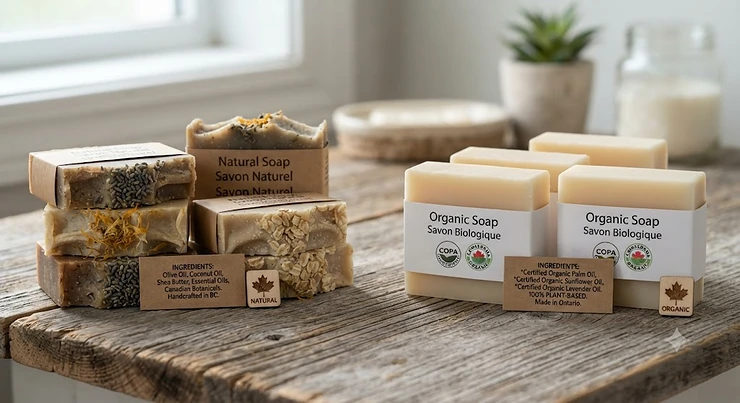
Stand in front of a Canadian drugstore’s soap aisle for five minutes and you’ll see the same two words doing a lot of heavy lifting: “natural” and “organic.” They get stamped on packaging like they’re interchangeable, and honestly, most shoppers treat them that way too. But natural soap vs organic soap is not a matter of one being a fancier version of the other — they’re answering two completely different questions. “Natural” is mostly about what a soap isn’t (synthetic dyes, petroleum-derived detergents, artificial preservatives), while “organic” is about how the raw ingredients were actually grown, and — as you’ll see below — who’s allowed to verify that claim in Canada is a lot more complicated than most labels let on.
This matters more than it sounds like it should. Skin is your body’s largest organ, and what touches it daily gets absorbed at least partially, which is part of why so many Canadians are paying closer attention to bar soap ingredients in 2026. But paying attention only helps if you know what the words on the label are actually promising you — and what they’re quietly not.
Below, we’ll break down the real distinction between natural and organic soap, walk through exactly how organic certification works (and doesn’t work) for cosmetics in Canada, flag the greenwashing patterns worth watching for, and review seven real bars sold to Canadian shoppers so you can see the difference in practice rather than just in theory.
What Is Natural Soap vs Organic Soap?
Natural soap is made mainly from plant oils, animal fats, or their derivatives, saponified with minimal synthetic additives — but “natural” is not a regulated or certified term in Canada. Organic soap uses ingredients grown without synthetic pesticides or fertilizers, though true third-party organic certification for cosmetics remains rare and inconsistently enforced here.
That gap between the claim and the certification is really the whole story, and it’s why the rest of this guide leans so heavily on labelling rules rather than marketing copy.
Quick Comparison Table: Natural vs Organic Soap at a Glance
| Factor | Natural Soap | Organic Soap |
|---|---|---|
| Regulatory status in Canada | Unregulated marketing term | Not eligible for the federal Canada Organic logo (cosmetics excluded) |
| What it actually promises | Fewer synthetic additives, plant/animal-derived base | Ingredients grown under organic agricultural practices |
| How it’s verified | Rarely verified by anyone | Verified only through private/foreign certifiers (Ecocert, USDA, COSMOS, Regenerative Organic Certified) |
| Typical price range (CAD) | around C$5–C$10 per bar | around C$6–C$12 per bar |
| Best for | Budget-conscious buyers avoiding harsh detergents | Buyers who want traceable, third-party-verified sourcing |
Here’s the thing worth sitting with: neither column in that table is inherently “better” in a vacuum — a natural soap made with simple, recognizable ingredients can be just as gentle as a certified organic one, and a soap slapped with an “organic” sticker with no certification body behind it can be less trustworthy than an honest “natural” bar. What actually separates good from mediocre in this category is verification, not vocabulary. That’s especially true once you learn — as we’ll get into shortly — that Canada’s own organic regime doesn’t even apply to soap.
💬 Just one click — help others make better buying decisions too!😊
Top 7 Natural and Organic Soap Bars: Expert Analysis
We looked at real products currently sold to Canadian shoppers, spanning budget, mid-range, and premium tiers, plus a few ingredient categories (castile, shea, African black soap, mineral) so there’s a genuine fit here whatever your skin is asking for.
1. Dr. Bronner’s Pure-Castile Bar Soap — Regenerative Organic Certified oils, zero synthetic detergents
Dr. Bronner’s Pure-Castile Bar Soap is arguably the closest thing this category has to a benchmark, and it earns that reputation honestly. The standout here is that its core oils — coconut, olive, hemp, and palm — carry Regenerative Organic Certified status, a private third-party standard that goes beyond typical organic agriculture rules to also cover soil health and fair labour practices.
The bar is a true soap (saponified oil, not a synthetic detergent bar), which means it produces a noticeably different lather than commercial “beauty bars” — thinner, less foamy, but it rinses completely clean rather than leaving a filmy residue. Based on the spec comparison with mainstream bar soap, the absence of synthetic surfactants like sodium lauryl sulfate is the real functional difference buyers notice, not just marketing language.
Who should care: anyone with reactive or eczema-prone skin, since Dr. Bronner’s Pure-Castile Bar Soap skips synthetic fragrance and dye entirely in its unscented version, and anyone who wants a soap that can double as a mild shampoo bar or all-purpose cleaner in a pinch. Reviewers consistently report that the true-soap lather takes a bar or two to get used to if you’re coming from a foaming body wash, and a recurring theme in aggregated feedback is that the bar softens faster in a wet, un-drained soap dish than most commercial bars — a small but real maintenance quirk.
Pros:
- ✅ Regenerative Organic Certified oils with transparent sourcing
- ✅ No synthetic detergents, dyes, or preservatives in the formula
- ✅ Multi-purpose — face, body, hair, even light cleaning
Cons:
- ❌ Dissolves faster than synthetic bars without a draining dish
- ❌ Thinner lather feel takes adjustment for foaming-bar users
At around C$6–C$8 for a single bar, or C$28–C$34 for a 6-pack at the time of research, Dr. Bronner’s Pure-Castile Bar Soap delivers strong per-wash value given how long a true-soap bar typically lasts versus a detergent bar of similar size.
2. Kirk’s Natural Coco Castile Soap — simple four-ingredient formula since 1839
Kirk’s Natural Coco Castile Soap leans hard into minimalism, and that’s really its whole pitch: a coconut-oil-based castile bar with a short, pronounceable ingredient list that hasn’t changed dramatically in generations.
The formula is built primarily on saponified coconut oil, which produces a notably bubblier, more voluminous lather than olive-oil-heavy castile bars — a practical distinction that matters if you find true soap lather underwhelming. It’s also formulated to perform in both hard and soft water, which on paper means fewer of the chalky, sticky residues some castile soaps leave behind in hard-water regions of the Prairies or parts of Ontario.
Who this suits: budget-conscious households who want a fragrance-free option for sensitive skin without paying a premium for certification marketing, and people specifically hunting for a genuinely short ingredient list. What most buyers overlook about this brand is its longevity in the market — it’s one of the oldest continuously produced natural soap brands in North America, which at minimum suggests a stable, unchanged formula rather than a trend-driven reformulation. Aggregated reviewer sentiment frequently mentions the bar’s mildness for babies and sensitive-skin users, though a recurring critique is that fragrance-free versions can feel slightly drying for very dry skin types without a follow-up moisturizer.
Pros:
- ✅ Short, simple, recognizable ingredient list
- ✅ Performs well in both hard and soft water
- ✅ Long manufacturing history with a stable formula
Cons:
- ❌ Not third-party organic certified
- ❌ Fragrance-free version can feel drying for very dry skin
Priced around C$5–C$7 for a single 4 oz bar, or C$12–C$16 for a 3-pack at the time of research, Kirk’s Natural Coco Castile Soap is one of the better value entry points into true castile soap.
3. ATTITUDE Body Soap Bar — Made-in-Canada, plastic-free, EWG Verified
ATTITUDE Body Soap Bar stands out simply because it’s a genuinely Canadian-made option, produced at the brand’s Quebec facility, which matters to shoppers specifically trying to reduce cross-border shipping footprint or support domestic manufacturing.
Formulated around coconut and olive oils, the bar is EWG Verified — meaning the U.S.-based Environmental Working Group has screened the formula against its ingredient hazard database — and packaged in FSC-certified cardboard with no plastic wrapper at all. Here’s what the spec sheet won’t tell you outright: EWG Verified is a private ingredient-safety screen, not an organic certification, so it speaks to what’s excluded (parabens, phthalates, PEGs) rather than to how the ingredients were farmed.
Who should care: shoppers prioritizing plastic-free packaging and domestic production over strict organic sourcing, and people with mild sensitivities who want a third-party ingredient screen without paying premium organic pricing. Reviewers consistently note the scent strength as noticeably more perfumed than castile-style bars, which is a genuine trade-off worth knowing before you buy a scent you can’t return once opened.
Pros:
- ✅ Made in Canada with FSC-certified plastic-free packaging
- ✅ EWG Verified ingredient safety screening
- ✅ Wide range of scent options across the same base formula
Cons:
- ❌ EWG Verified is not an organic agriculture certification
- ❌ Fragrance level runs stronger than unscented castile bars
At around C$6–C$8 per 113 g bar at the time of research, ATTITUDE Body Soap Bar sits in the mid-range for Canadian-made natural soap.
4. Nubian Heritage African Black Soap — traditional palm ash and shea butter formulation
Nubian Heritage African Black Soap brings a genuinely different ingredient tradition to this list, built around a base of palm ash, plantain peel extract, and shea butter rather than the coconut/olive castile formula that dominates the natural soap aisle.
Traditionally, African black soap formulations rely on palm ash as the alkaline saponifying agent instead of the sodium hydroxide lye process typical of most bar soap, which on paper explains its darker colour and slightly gritty, exfoliating texture. Combined with shea butter, the formula is positioned toward oilier and blemish-prone skin types rather than sensitive, dry skin.
Who this fits: buyers dealing with oily or acne-prone skin who want an exfoliating cleanse without a harsh scrub product layered on top, and anyone drawn to traditional, small-batch-style formulations over lab-designed ones. A common theme in aggregated customer feedback is that first-time users are surprised by the texture — it’s noticeably softer and more crumbly than a typical bar — and a frequent complaint is that the bar dissolves faster than expected if left sitting in standing water. Reviewers also consistently note it can feel drying with daily use on non-oily skin, so it’s not a universal daily bar for every skin type.
Pros:
- ✅ Traditional palm-ash formulation, distinct from standard castile
- ✅ Exfoliating texture suited to oily or blemish-prone skin
- ✅ Shea butter helps offset the exfoliating base
Cons:
- ❌ Softer texture dissolves faster than standard bar soap
- ❌ Can feel drying with daily use on non-oily skin
Expect to pay around C$8–C$10 per 5 oz bar at the time of research — Nubian Heritage African Black Soap sits at the higher end of this list but is targeting a specific skin concern rather than general use.
5. One With Nature Dead Sea Mineral Soap — mineral-rich formula from actual Dead Sea salt and mud
One With Nature Dead Sea Mineral Soap takes a different angle entirely, built around genuine Dead Sea salt and mud combined with a vegetable oil base and shea butter, marketed on mineral content rather than organic agriculture.
The mineral inclusion (magnesium, potassium, and other trace minerals naturally present in Dead Sea salt) is the brand’s core differentiator, and what the spec sheet doesn’t spell out is that these minerals are associated in dermatological literature with mild anti-inflammatory and skin-barrier benefits, though results vary significantly by individual skin type. The triple-milled processing method it uses produces a noticeably denser, longer-lasting bar than single-milled soaps.
Who should care: buyers managing mild skin irritation, eczema-adjacent dryness, or those who simply want a spa-style bar without visiting a spa, and people who prioritize bar longevity over the absolute lowest sticker price. Aggregated reviewer sentiment frequently highlights the bar’s density and slow-wear as a standout, while a recurring complaint is that some scent variants carry a stronger fragrance than the “natural mineral” branding might suggest.
Pros:
- ✅ Genuine Dead Sea mineral content, not just marketing language
- ✅ Triple-milled for longer bar life per wash
- ✅ Shea butter base softens the mineral formula’s dryness risk
Cons:
- ❌ Not organic certified in any capacity
- ❌ Some scent variants are more perfumed than expected
Priced around C$7–C$9 per 7 oz bar at the time of research, One With Nature Dead Sea Mineral Soap delivers solid value given its size and bar density relative to lighter, faster-dissolving competitors.
6. Alaffia EveryDay Shea Soap Bar — fair trade shea butter from a women-led co-operative
Alaffia EveryDay Shea Soap Bar distinguishes itself on supply-chain transparency: the shea butter is unrefined and handcrafted at a fair-trade co-operative in Togo, West Africa, which the brand documents directly rather than through a third-party seal alone.
Triple-milled for a denser bar, the formula centres on unrefined shea butter combined with coconut oil and aromatic plant extracts, aiming for a moisturizing profile rather than a deep-cleanse one. Based on the ingredient comparison with more detergent-forward “beauty bars,” the higher fat-to-cleanser ratio here means less stripping of natural skin oils, which particularly benefits drier or more mature skin types.
Who this suits: buyers who prioritize fair trade and traceable sourcing as much as the ingredient list itself, and anyone with dry or sensitive skin who wants a moisture-forward bar rather than a foam-forward one. What most buyers overlook is that fair trade certification, while genuinely meaningful for labour practices, is a separate claim from organic agricultural certification — the two aren’t the same thing even though they often get bundled together in marketing. Reviewers consistently note the bar’s rich, dense lather and moisturizing after-feel, with the main recurring critique being a relatively strong lavender scent in the standard variant for anyone sensitive to florals.
Pros:
- ✅ Fair trade shea butter from a documented women-led co-op
- ✅ Higher fat content suited to dry or mature skin
- ✅ Triple-milled for a denser, longer-lasting bar
Cons:
- ❌ Fair trade certification is separate from organic certification
- ❌ Standard scent variant can be strong for floral-sensitive users
At around C$22–C$26 for a 4-pack (8 oz bars) at the time of research, Alaffia EveryDay Shea Soap Bar is a strong per-bar value once split across the pack.
7. SheaMoisture African Black Soap Bar — accessible drugstore pricing with 24-hour shea moisture claims
SheaMoisture African Black Soap Bar rounds out this list as the most widely accessible option, sold at mainstream Canadian drugstores and grocery retailers as well as online, combining African black soap tradition with the brand’s broader shea-focused product philosophy.
The formula blends African black soap with what the brand markets as “24-hour shea moisture nutrients,” and on paper, that translates to a higher moisturizing-ingredient ratio than a traditional black soap bar, aimed at softening the exfoliating, sometimes-drying reputation black soap carries. It’s soothing and clarifying by design, positioned toward combination and blemish-prone skin rather than very dry skin.
Who should care: first-time black-soap users nervous about the traditional formula’s drying reputation, and shoppers who want the African black soap category without hunting down a specialty retailer. A common theme in aggregated review sentiment is appreciation for the accessible pricing and wide retail availability relative to smaller-batch black soap brands, while a recurring complaint flags that the scent and lather feel more “commercial” and less traditional than smaller-batch alternatives like our #4 pick above.
Pros:
- ✅ Widely available at mainstream Canadian retailers
- ✅ Softer, less drying take on traditional black soap
- ✅ More accessible pricing than boutique black soap brands
Cons:
- ❌ Less traditional formulation than small-batch black soap
- ❌ Not organic certified
Expect around C$7–C$9 for a single bar, or C$28–C$34 for a 6-pack at the time of research — SheaMoisture African Black Soap Bar is the practical, everywhere-available pick on this list.
Top 7 Products Comparison Table
| Product | Base Ingredient | Price Range (CAD) | Best For |
|---|---|---|---|
| Dr. Bronner’s Pure-Castile Bar Soap | Coconut, olive, hemp oils | around C$6–C$8/bar | Sensitive, reactive skin |
| Kirk’s Natural Coco Castile Soap | Coconut oil | around C$5–C$7/bar | Budget-conscious buyers |
| ATTITUDE Body Soap Bar | Coconut, olive oils | around C$6–C$8/bar | Plastic-free, Canadian-made preference |
| Nubian Heritage African Black Soap | Palm ash, shea butter | around C$8–C$10/bar | Oily, blemish-prone skin |
| One With Nature Dead Sea Mineral Soap | Dead Sea salt, mud, shea | around C$7–C$9/bar | Mild irritation, eczema-adjacent dryness |
| Alaffia EveryDay Shea Soap Bar | Unrefined shea butter | around C$22–C$26/4-pack | Dry or mature skin |
| SheaMoisture African Black Soap Bar | African black soap, shea | around C$7–C$9/bar | First-time black soap users |
Looking at the table, the split isn’t really “natural” versus “organic” at all — it’s cleansing intensity versus moisture retention. Nubian Heritage African Black Soap and SheaMoisture African Black Soap Bar sit on the exfoliating, oil-clearing end, while Alaffia EveryDay Shea Soap Bar and One With Nature Dead Sea Mineral Soap sit on the moisture-forward end, with Dr. Bronner’s Pure-Castile Bar Soap and Kirk’s Natural Coco Castile Soap occupying the flexible, all-purpose middle. Budget shoppers should note that per-wash cost usually favours the denser, triple-milled bars even when the sticker price looks higher.
✨ Don’t Miss These Exclusive Deals!
🔍 Take your skincare routine to the next level with these carefully selected soap bars. Click on any highlighted item to check current pricing and availability on amazon.ca. Small swaps like these add up to genuinely healthier daily habits your whole household will notice!
Natural vs Organic Ingredients: What’s Actually Different
The phrase natural vs organic ingredients gets used loosely, but the technical difference is straightforward once you separate two questions: what’s in the product, and how was it grown.
A natural ingredient is one derived from a plant, mineral, or animal source rather than synthesized in a lab — coconut oil, shea butter, and Dead Sea salt all qualify as natural regardless of how the coconut palm or shea tree was farmed. An organic ingredient adds a specific agricultural condition on top of that: it must be grown without synthetic pesticides, synthetic fertilizers, or genetically modified inputs, and — critically — verified as such by an accredited third party.
That verification step is where the real gap opens up. A brand can accurately call an oil “natural” without any outside checking, because the term describes the ingredient’s origin, not a regulated production standard. Calling the same oil “organic,” on the other hand, is supposed to require certification — but as the next section explains, that requirement barely applies to soap in Canada at all, which leaves a lot of room for the word to be used more loosely on cosmetic labels than it legally can be on, say, a bag of organic carrots.
Organic Soap Certification Canada: The Rule Most Shoppers Don’t Know
Here’s the detail that reframes this entire category: the Canadian Food Inspection Agency confirms that cosmetics, along with natural health products and pet food, are explicitly excluded from the Canada Organic Regime. That means bar soap — no matter how it’s formulated — cannot be certified organic under Canada’s own federal system, and cannot legally display the Canada Organic logo.
What this means in practice: any “organic” claim on a bar soap sold in Canada is not being backed by the same federal oversight that governs, say, organic oats or organic milk. Instead, brands rely on private or foreign certification bodies — Ecocert, USDA Organic, COSMOS Organic, or the Regenerative Organic Alliance’s Regenerative Organic Certified mark used by Dr. Bronner’s Pure-Castile Bar Soap — none of which are mandated or monitored by the CFIA the way food organic claims are. It’s a genuinely useful distinction for organic soap certification Canada shoppers to understand before assuming a green leaf icon on a soap wrapper carries the same weight as it does on a carton of eggs.
Certified Organic Bodies: Who Actually Verifies the Claims
Since Canada’s federal organic system doesn’t cover soap, the certified organic bodies doing the actual verification work for cosmetics are almost entirely private or foreign organizations, each with its own standard and threshold.
- Ecocert — a France-based certifier that also operates in Canada for agricultural products, and is widely used internationally for cosmetic ingredient sourcing, though its cosmetic standard (COSMOS) is separate from its Canada Organic Regime agricultural accreditation.
- USDA Organic — the American federal standard; ingredients certified this way (like those in some Dr. Bronner’s Pure-Castile Bar Soap formulations) meet U.S. agricultural organic rules, not Canadian ones, though Canada does maintain equivalency arrangements for some food categories.
- COSMOS Organic — a cosmetics-specific European standard that verifies both the organic content and the manufacturing process of the finished product, arguably the closest thing to a true “organic soap” certification that exists.
- Regenerative Organic Certified — issued by the Regenerative Organic Alliance, layering soil-health and labour standards on top of baseline organic agriculture requirements.
The Canada Organic Trade Association notes that provincial organic regulations exist in British Columbia, Manitoba, Quebec, Nova Scotia, New Brunswick, and Alberta — but these largely govern food products sold within provincial borders, not cosmetics. Practically speaking, if a soap label cites a certification body by name, that’s a stronger signal than an unattributed “organic” claim with no verifier named at all.
Soap Labelling Standards Canada: What Actually Has to Be on the Wrapper
Even without organic certification applying to soap, Canadian soap labelling standards still impose real, enforceable requirements — they’re just about disclosure rather than agricultural sourcing.
Under the Consumer Packaging and Labelling Act and Health Canada’s cosmetic labelling guidance, a pre-packaged cosmetic sold in Canada must disclose the product identity, net quantity, and dealer (manufacturer/distributor) name and address, and must present that information bilingually in English and French. Manufacturers and importers are also required to submit a Cosmetic Notification Form to Health Canada within ten days of first sale, listing the full formulation — a post-market disclosure system rather than a pre-approval one.
Full ingredient lists must appear using standardized INCI naming (the same international nomenclature used across most Western markets), and — importantly — cosmetic ingredient lists in Canada cannot be split into “active” and “inactive” categories, since that distinction is reserved for products regulated as drugs or natural health products. For bulk or unpackaged bar soap sold loose at a market stall, a nearby leaflet or display card with the same ingredient information satisfies the requirement instead of an on-bar label. None of this regulates whether a soap is “natural” or “organic” — it only regulates whether you’re told, accurately, what’s actually in the bar.
Greenwashing Concerns: Spotting Vague “Natural” Claims
Greenwashing concerns are exactly what you’d expect given the gap between marketing language and certification described above — and Canadian regulators have recently sharpened their teeth on this specific issue.
As of June 2024, amendments to the Competition Act added provisions explicitly targeting environmental claims: businesses must now have “adequate and proper testing” to support product-level environmental benefit claims, and “adequate and proper substantiation” for broader business-level sustainability claims. The Competition Bureau actively investigates complaints under this framework, assessing not just a claim’s literal wording but the “general impression” it creates in a reasonable consumer’s mind — meaning a soap wrapper covered in leaves and earth tones without an actual organic or environmental claim in text may still be scrutinized if it creates a misleading overall impression.
For soap shoppers specifically, the practical greenwashing red flags worth watching for are: an “organic” claim with no certifier named anywhere on the label or brand website; vague terms like “eco-friendly” or “clean” with no defined standard behind them; and packaging imagery (leaves, water droplets, green colour palettes) doing more communicative work than the actual ingredient list. None of the seven products reviewed above make unsubstantiated organic claims — they either cite a real certifier by name (like Dr. Bronner’s Pure-Castile Bar Soap‘s Regenerative Organic Certified oils) or market themselves honestly as natural without an organic claim attached, which is itself a useful signal of a more trustworthy brand.
How to Choose Between Natural Soap and Organic Soap
- Identify your actual skin concern first. Oily or blemish-prone skin generally does better with an exfoliating, palm-ash-based bar like Nubian Heritage African Black Soap, while dry or mature skin benefits more from a moisture-forward bar like Alaffia EveryDay Shea Soap Bar.
- Check for a named certifier, not just the word “organic.” As covered above, an unattributed organic claim on Canadian soap carries far less weight than a specific certification like Ecocert, USDA Organic, or Regenerative Organic Certified.
- Read the full ingredient list, not just the front label. A short, recognizable INCI list is often a better practical signal of formula simplicity than either the word “natural” or “organic” alone.
- Decide how much you value supply-chain transparency. If fair trade sourcing or domestic manufacturing matters to you as much as the organic question, options like Alaffia EveryDay Shea Soap Bar or ATTITUDE Body Soap Bar may outweigh a purely certification-focused pick.
- Factor in bar density and expected lifespan, not just sticker price. Triple-milled bars like One With Nature Dead Sea Mineral Soap last noticeably longer per wash than softer, faster-dissolving bars.
- Match fragrance intensity to your sensitivity level. Unscented castile options like Kirk’s Natural Coco Castile Soap are the safer default for reactive skin, regardless of natural or organic status.
- Set a realistic budget band before you shop. Most solid options on this list land between roughly C$5 and C$12 per bar at the time of research — paying dramatically more rarely buys you a meaningfully different formula.
Common Mistakes When Buying Natural or Organic Soap
Even careful shoppers fall into a handful of predictable traps in this category, and most of them trace back to trusting front-of-package language over the actual formulation.
The single most common mistake is assuming “organic” on a soap label means the same thing it means on food — as this guide has covered, it almost never does, since cosmetics fall outside Canada’s federal organic system entirely. A second frequent error is assuming a higher price automatically signals better sourcing; some premium-priced bars carry no third-party certification at all, while a comparatively affordable pick like Kirk’s Natural Coco Castile Soap offers a genuinely short, transparent ingredient list at a fraction of the cost. A third mistake is buying based on scent appeal alone and ignoring base ingredients entirely — a heavily fragranced bar can still be built on a mild, skin-friendly base, or conversely, a subtly scented bar can contain more potential irritants than its marketing suggests. Finally, many buyers skip the ingredient list altogether and rely purely on packaging colour palettes and imagery, which — per the greenwashing concerns discussed earlier — is precisely the kind of “general impression” that Canadian regulators now scrutinize for being misleading even without an explicit false claim in the text.
Features That Actually Matter (And Those That Don’t)
Stripping away the marketing noise, a handful of features genuinely predict how a bar soap will perform, while several popular buzzwords add little practical value.
What matters: the base oil ratio (coconut oil for lather volume, olive or shea for moisture), whether the formula is a true saponified soap versus a synthetic detergent bar, and whether any organic or fair trade claim names a specific verifying body. What doesn’t move the needle nearly as much as marketing suggests: colour (natural pigments vary batch to batch regardless of quality), the word “handmade” alone (as one soap maker’s own blog puts it, saying a soap is handmade says nothing about ingredient quality or the maker’s skill), and vague “detox” or “purifying” language, which has no standardized meaning in Canadian cosmetic regulation. Buyers chasing genuine quality should weight ingredient transparency and named certification far more heavily than scent, colour, or evocative marketing copy.
Practical Usage Guide: Getting the Most Out of a Natural Soap Bar
True soap bars — the castile and shea-based options on this list especially — behave differently from synthetic detergent bars, and a few habits make a real difference in how long they last and how they perform.
Store the bar on a well-draining soap dish rather than a flat, non-draining surface; standing water is the single biggest cause of premature dissolving, especially for softer bars like Nubian Heritage African Black Soap. In the first week of use, expect a lather that feels thinner or less foamy than a synthetic bar — this is normal for true soap and isn’t a sign of a diluted or defective product. For hard-water regions, a bar like Kirk’s Natural Coco Castile Soap that’s formulated to perform in both hard and soft water avoids the chalky film some castile soaps leave behind; if you notice residue with other bars, a quick post-rinse with slightly acidic water (a small splash of diluted vinegar rinsed off immediately) can help. Letting the bar fully air-dry between uses roughly doubles its lifespan compared to leaving it in a closed, humid shower caddy. A common first-30-days mistake is switching bars too quickly after one underwhelming shower — true soap often needs two or three uses for skin to adjust, particularly if you’re transitioning from a foaming synthetic body wash.
Real-World Scenarios: Which Bar Fits Which Life
Matching a soap to an actual routine, rather than an abstract ingredient checklist, usually produces a better result than shopping by label alone.
Consider a university student in Toronto sharing a dorm bathroom on a tight budget, dealing with combination skin and stress breakouts during exam season — Kirk’s Natural Coco Castile Soap or SheaMoisture African Black Soap Bar both fit that scenario well, offering an affordable, widely available option without a steep learning curve. A new parent in Halifax looking for a gentle, fragrance-free option safe for both themselves and a baby’s sensitive skin is better served by the unscented version of Dr. Bronner’s Pure-Castile Bar Soap, given its minimal ingredient list and lack of synthetic fragrance. And a homeowner in Calgary dealing with notoriously hard prairie water and dry winter skin would likely get more consistent results from Alaffia EveryDay Shea Soap Bar‘s higher fat content, which resists the stripping effect hard water can have on skin barrier function. None of these scenarios require an organic certification to solve the actual problem — they require matching base ingredients and skin needs correctly, which is really the whole point of this guide.
Long-Term Cost & Maintenance: What Bar Soap Actually Costs Over a Year
Per-bar sticker price is a misleading way to compare these products, since bar density, usage frequency, and household size all swing the real cost significantly.
A denser, triple-milled bar like One With Nature Dead Sea Mineral Soap typically outlasts a softer, faster-dissolving bar like Nubian Heritage African Black Soap by a meaningful margin under identical daily use, even though their sticker prices are close. Multi-packs generally offer a better effective per-bar cost — Alaffia EveryDay Shea Soap Bar‘s 4-pack format, at roughly C$22–C$26 total at the time of research, works out to a comparable or lower per-bar cost than several single-bar competitors once you divide it out. For a single daily user, a typical bar in the 4–5 oz range lasts somewhere in the range of three to five weeks with proper draining storage, meaning most of the products on this list translate to a modest monthly cost regardless of which one you pick — the real long-term cost driver is less about brand choice and more about storage habits, since a soap left sitting in standing water can burn through a bar’s lifespan noticeably faster than one properly drained between uses.
Benefits vs Conventional Commercial Soap
| Factor | Natural/Organic-Leaning Soap | Conventional Commercial Bar Soap |
|---|---|---|
| Detergent type | True saponified soap (most options) | Often synthetic detergent-based |
| Fragrance | Frequently fragrance-free or essential-oil based | Usually synthetic fragrance compounds |
| Ingredient transparency | Short, INCI-labelled ingredient lists | Longer lists, more proprietary blends |
| Packaging | Often plastic-free or recyclable | Frequently plastic-wrapped |
| Price range (CAD) | around C$5–C$12/bar | around C$2–C$6/bar |
The clearest takeaway from this table is that the price gap is real but modest — you’re typically paying roughly double for a natural or organic-leaning bar compared to a mainstream commercial one, not an order of magnitude more. For buyers managing reactive or sensitive skin, that premium is often justified by the shorter, more transparent ingredient list; for buyers without specific skin concerns, a conventional bar may genuinely perform just fine, and the choice comes down more to personal values around packaging and sourcing than a strict performance gap.
Frequently Asked Questions
❓ Is organic soap better than natural soap?
❓ Can soap be certified organic in Canada?
❓ What ingredients should I avoid in bar soap?
❓ Is natural soap good for sensitive skin?
❓ How long does a bar of natural soap last?
Conclusion
The real answer to natural soap vs organic soap isn’t that one category beats the other — it’s that “organic” carries far less regulatory weight on a Canadian soap wrapper than most shoppers assume, since cosmetics sit entirely outside the Canada Organic Regime. That doesn’t make organic-leaning soap a bad choice; it just means the word alone isn’t proof of anything, and a named third-party certifier matters more than the label vocabulary.
Among the seven bars reviewed here, there’s no single universal winner — Dr. Bronner’s Pure-Castile Bar Soap earns its reputation through genuine Regenerative Organic Certified sourcing and sensitive-skin suitability, Kirk’s Natural Coco Castile Soap wins on simplicity and value, and Alaffia EveryDay Shea Soap Bar and Nubian Heritage African Black Soap each solve specific skin concerns that a one-size-fits-all pick can’t. The smartest move for any Canadian shopper in this category is the same regardless of which bar you land on: read the ingredient list, look for a named certifier if organic sourcing matters to you, and treat vague green packaging as marketing rather than proof.
✨ Don’t Miss These Exclusive Deals!
🔍 Ready to make the switch? Check current pricing and availability on any of the seven bars above, and give your skin — and your bathroom shelf — an honest upgrade this season.
Recommended for You
- Natural Soap for Sensitive Skin: 7 Gentle Picks for 2026
- Natural Soap Under $25 CAD: 7 Best Picks for Canadians (2026)
- Botanical Soap Gift Set: 7 Best Picks for Canada in 2026
Disclaimer: This article contains affiliate links. As an Amazon Associate, I earn from qualifying purchases. If you purchase products through these links, we may earn a small commission at no additional cost to you.
✨ Found this helpful? Share it with your friends! 💬🤗
