
In This Article
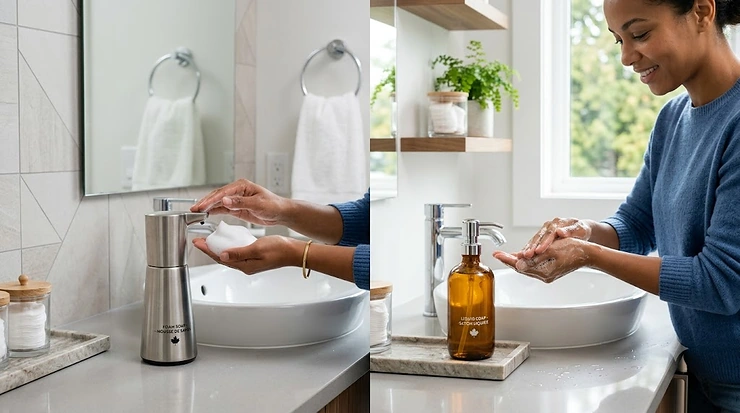
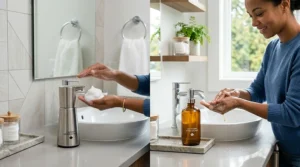
Foam soap and liquid soap both live in a pump bottle, but they behave very differently the moment they hit your palm. Foam soap arrives pre-mixed with air, so it lands as ready-made lather. Liquid soap comes out thicker and unfoamed — you build the lather yourself by rubbing your hands together. That one mechanical difference changes everything from how much product you use per wash to how your hands feel after a long Canadian winter at the sink.
If you’ve stood in the cleaning aisle at your local Canadian Tire or scrolled Amazon.ca wondering which bottle to toss in the cart, you’re not alone. The decision matters more here than it might seem: Canadian households tend to wash hands more often through cold and flu season, our tap water runs harder in places like Winnipeg and Calgary, and a lot of us are trying to cut down on plastic waste at the same time. 🇨🇦
This guide breaks down the real differences between foam soap vs liquid soap, walks through seven products genuinely available on Amazon.ca right now (including two made right here in Canada), and gives you a practical framework for picking the right one for your bathroom, kitchen, or mudroom — without falling for marketing language that sounds good on a bottle but doesn’t mean much in practice.
We’ll also get into the stuff that doesn’t show up on the product page: how foam soap performs once the temperature drops, what “antibacterial” actually requires under Canadian rules, and why the cheaper-looking bottle isn’t always the better deal once you do the math per wash.
Quick Comparison: Foam Soap vs Liquid Soap at a Glance
| Factor | Foam Soap | Liquid Soap | Best For |
|---|---|---|---|
| Lather | Pre-aerated, instant | You build it by rubbing hands together | Foam = speed, liquid = thorough scrub |
| Product used per pump | Roughly 0.25–0.4 mL | Roughly 1 mL | Foam tends to stretch further |
| Typical price (CAD) | ~$8–$18 per bottle/refill | ~$6–$15 per bottle/refill | Liquid often cheaper upfront |
| Skin feel | Lighter, less residue | Richer, more moisturizing formulas common | Liquid for very dry winter skin |
| Dispenser needed | Requires a foaming pump (air chamber) | Works with any standard pump | Liquid is more flexible |
| Amazon.ca free shipping | Orders of $35 CAD+ (non-Prime) | Same threshold | Bundle items to qualify |
Looking at the table, the headline trade-off is simple: foam soap is the efficiency play, while liquid soap is the thoroughness play. Foam’s pre-mixed air means less product leaves the bottle each pump, which is genuinely good news for your wallet and for water use at the rinse. Liquid soap’s thicker formula means you’re doing more of the physical work, which — as we’ll get into below — actually matters for how clean your hands end up.
💬 Just one click — help others make better buying decisions too! 😊
Top 7 Foam and Liquid Hand Soaps for Canadian Homes
These are real products currently listed on Amazon.ca, mixing budget, mid-range, and premium options across both foam and liquid formats — including two Canadian-made picks.
1. ATTITUDE Foaming Hand Soap (Made in Canada)
Standout feature: A foaming hand soap actually manufactured in Quebec, not just packaged for the Canadian market.
ATTITUDE’s foam soap is built on a roughly 98% naturally-derived formula, free of SLS/SLES and synthetic dyes, and it’s EWG Verified — meaning an independent body has reviewed the ingredient list, not just the marketing copy. For Canadian buyers who’ve gotten used to squinting at ingredient panels, that third-party check is worth something. What most shoppers overlook is that “natural” foaming formulas can sometimes foam less aggressively than synthetic ones; ATTITUDE’s glycerin-enriched mix manages to keep a decent lather without leaning on harsh surfactants, which matters if anyone in the house has sensitive or winter-dry skin. Reviewers commonly mention that the pump performs reliably and the scent is noticeable without being overpowering, which is a common complaint with stronger commercial foam soaps.
✅ Made and EWG Verified in Canada
✅ Gentle, low-residue formula suits dry winter hands
✅ Recyclable HDPE bottle
❌ Smaller bottle sizes (295 mL) mean more frequent reordering
❌ Premium pricing versus mainstream foam soaps
Price range: around $8–$13 CAD per bottle. Best for households prioritizing ingredient transparency over rock-bottom cost.
2. ATTITUDE Liquid Hand Soap (Made in Canada)
Standout feature: The liquid counterpart to the pick above, for sinks without a foaming dispenser.
If you like ATTITUDE’s ingredient philosophy but your kitchen sink only has a standard pump, this is the direct swap. The plant- and mineral-based formula is the same family as the foam version, just without the aeration. What stands out here for Canadian buyers is the option to grab the 2-litre bulk refill format, which significantly cuts the cost-per-wash compared to buying small bottles repeatedly — a detail that’s easy to miss when you’re comparing shelf prices rather than refill pricing. This is a good fit for a kitchen sink that gets heavy, food-prep-related use, since liquid soap’s thicker formula handles grease and stubborn grime a touch better than foam.
✅ Bulk refill option lowers long-term cost
✅ Same clean-ingredient standard as the foam line
✅ Better for greasy kitchen-sink duty than foam
❌ Bulk format needs a separate reusable pump bottle
❌ Not pre-foamed, so it takes a few seconds longer to lather
Price range: around $10–$16 CAD for the standard bottle; bulk refills bring the per-wash cost down further. Best for: kitchens and anyone refilling an existing pump bottle regularly.
3. Method Foaming Hand Soap
Standout feature: Pouch-style concentrate refills that cut plastic use dramatically versus rebuying full bottles.
Method’s foaming hand wash uses naturally-derived ingredients and ships its refills in a flat pouch rather than a rigid bottle — the company states this cuts the plastic footprint of each refill substantially compared to a standard bottle. For a Canadian household trying to reduce curbside waste without changing their whole routine, that’s a meaningfully easy swap. In practice, what most buyers don’t realize until they’ve used it is that you keep one reusable pump bottle indefinitely and just top it up from the pouch, so the ongoing cost is mostly just the concentrate. Scent strength is on the lighter side compared to drugstore brands, which some Canadian reviewers like for shared bathrooms and others find fades a bit fast in busy households with frequent hand-washers.
✅ Pouch refills meaningfully cut plastic waste
✅ Naturally derived, paraben- and phthalate-free
✅ Wide range of scents available on Amazon.ca
❌ Lighter scent throw than some competitors
❌ Refill pouches require care when pouring to avoid mess
Price range: around $9–$16 CAD depending on format. Best for: eco-conscious households that don’t mind a lighter fragrance.
4. Dial Complete Antibacterial Foaming Hand Soap Refill
Standout feature: Marketed as a “doctor recommended” antibacterial brand, with large refill sizes built for high-traffic households.
Dial’s foaming antibacterial wash uses benzalkonium chloride as its active ingredient — the same family of antiseptic agent used in many over-the-counter hand cleansers — and the brand positions this specifically for households that want an active disinfecting claim rather than a plain cosmetic cleanser. The practical thing to know before buying: in Canada, soap that makes a “kills bacteria” claim is generally regulated differently than ordinary cosmetic soap and needs Health Canada review for that specific claim, so check that the bottle shows the relevant authorization number rather than relying on the word “antibacterial” alone. For most everyday home use, plain soap and proper technique already does the job (more on that below), so this is really best suited to households with someone immunocompromised, very young, or recovering from illness, rather than a default daily pick.
✅ Large refill sizes cut cost-per-wash for big families
✅ Aloe-enriched, dermatologist-tested formula
✅ Recycled-plastic bottle
❌ Antibacterial claim isn’t necessary for most everyday handwashing
❌ Refill bottles are bulky to store under a small Canadian condo sink
Price range: around $12–$20 CAD for refill sizes. Best for: households that genuinely need an antiseptic-grade wash, not everyday general use.
5.Softsoap Moisturizing Liquid Hand Soap
Standout feature: One of the best-selling, most widely stocked liquid hand soaps on Amazon.ca, at a genuinely low per-bottle price.
Softsoap’s aloe vera moisturizing formula is dermatologist-tested and pH-balanced, and it consistently shows up as a bestseller in Amazon.ca’s hand soap category — which usually means it’s also easy to find in-stock during cold and flu season, when demand spikes. The practical upside for Canadian buyers is price: at roughly the cost of a coffee, this is the soap to default to for a guest bathroom, a kids’ bathroom, or anywhere you just need a reliable, unscented-leaning option without overthinking it. What it lacks is the “responsible beauty” certification language that pricier brands lean on, but for day-to-day cleansing that’s not really the job it’s being asked to do.
✅ Genuinely budget-friendly, even in multi-packs
✅ Dermatologist-tested, pH-balanced formula
✅ Reliably in stock on Amazon.ca
❌ Fewer “clean ingredient” certifications than premium picks
❌ Standard plastic packaging, no refill-pouch option
Price range: around $6–$12 CAD per bottle depending on size and pack count. Best for: budget-conscious households and high-traffic bathrooms.
6. Mrs. Meyer’s Clean Day Foaming Hand Soap
Standout feature: Essential-oil-based “garden fresh” scents (lavender, lemon verbena, basil) that feel more like a self-care moment than a chore.
Mrs. Meyer’s leans on essential oils, aloe vera, and olive oil rather than a long synthetic fragrance list, and the foaming version specifically is designed to be non-drying for “busy hands and families.” The thing worth knowing before buying: Mrs. Meyer’s liquid hand soap line is genuinely not foaming, so make sure you’re ordering the foaming SKU specifically if that’s what your dispenser needs — easy to mix up since the bottle design looks similar across both lines. For a Canadian bathroom that doubles as a small sensory pick-me-up during long, grey winters, the scent range here does more emotional heavy lifting than most drugstore soaps even attempt.
✅ Distinctive essential-oil scents, not synthetic-smelling
✅ Cruelty-free formula
✅ Concentrated refills available to cut long-term cost
❌ Easy to accidentally buy the non-foaming liquid version by mistake
❌ Premium pricing relative to mainstream foam soaps
Price range: around $9–$15 CAD per bottle. Best for: guest bathrooms and anyone who wants hand soap to also smell genuinely nice.
7. J.R. Watkins Gel Hand Soap Refill
Standout feature: A plant-based gel hand soap with refill pouches designed to top up the same bottle multiple times.
J.R. Watkins has been making personal care products since 1868, and its gel hand soap line skips foaming entirely in favour of a richer, non-drying gel formula with skin-nourishing ingredients like oat extract and vitamin E. The refill pouches are built to fill a standard bottle up to three times, which is a genuinely useful way to cut down on bottle waste if you’ve already got one you like at the sink. Worth flagging honestly: this is a U.S.-made product, so while it ships reliably through Amazon.ca, it doesn’t carry the “Made in Canada” angle that ATTITUDE offers — it earns its spot here on formula quality and refill economics rather than origin.
✅ Refill pouches stretch one bottle across multiple top-ups
✅ Plant-based, cruelty-free, dye-free formula
✅ Gentle enough for multiple daily washes
❌ Made in the U.S., not Canada
❌ Gel format isn’t foaming, so it won’t suit a foam-only dispenser
Price range: around $10–$18 CAD per bottle, with multi-packs offering better per-unit value. Best for: kitchen sinks and anyone who washes hands frequently throughout the day.
✨ Don’t Miss These Exclusive Deals!
🔍 Take your hand-washing routine to the next level with these carefully selected picks. Click on any highlighted item to check current pricing and availability on Amazon.ca. A small swap here can mean less plastic waste and a lower cost-per-wash all year long!
How to Choose Between Foam and Liquid Soap in Canada
If you’re still not sure which format fits your home, run through this short checklist:
- Check your dispenser first. A foaming pump has an internal mesh that mixes air into the soap — a regular liquid soap poured into it will barely lather. If you already own a foam dispenser, buy foam (or diluted liquid, covered below).
- Think about who’s washing. Foam encourages quick, light coverage — great for kids and guests, less ideal if hands are visibly greasy or dirty.
- Match the room to the job. Kitchens dealing with grease benefit from liquid soap’s thicker, scrub-friendly texture; bathrooms used for quick hygiene washes do fine with foam.
- Decide how much “natural” matters to you. If ingredient transparency is a priority, look for third-party verification (EWG Verified, Leaping Bunny) rather than just label language.
- Calculate cost per wash, not per bottle. A $16 CAD foam refill that lasts twice as long as an $8 CAD liquid bottle isn’t actually more expensive — more on this in the cost section below.
- Consider winter storage. If the soap lives somewhere unheated (a garage, a cottage, a mudroom), liquid formulas with fewer natural stabilizers can thicken or separate in near-freezing temperatures more than mainstream synthetic formulas.
- Check Amazon.ca availability and shipping. Not every U.S. listing ships to Canada, and remote postal codes may see longer delivery windows even on in-stock items.
Foam vs Liquid: Which One Actually Cleans Better?
This is the question that matters most, and the honest answer is a little more nuanced than either side of the debate likes to admit.
A small but frequently cited hospital-based pilot study comparing foam and liquid versions of the same brand of soap found that the liquid version reduced hand bacteria counts more effectively than the foam version in that test. Foam soap was not as effective as liquid soap in eliminating hand bacterial load in those pilot experiments, and the researchers suggested this was tied to two mechanical differences: liquid soap requires you to physically build the lather through rubbing — which itself helps dislodge germs — while foam soap arrives already lathered, so you skip that scrubbing step; and foam dispensers simply put out less soap per pump than liquid ones. The study’s authors were upfront that it was small and not rigorously controlled, so it shouldn’t be read as the final word — but it’s a real, peer-reviewed data point worth knowing about, not just internet folklore.
That said, broader public-health guidance consistently lands on a more important point: good hand-washing technique — using enough soap and rubbing hands together to create friction for at least 20 seconds before rinsing under running water — matters more than which soap format you use. In other words, a thorough 20-second foam wash will almost certainly beat a rushed 5-second liquid-soap splash. Format is a secondary factor; technique is the primary one.
For Canadian households, the practical takeaway is this: if you’re washing hands after handling raw chicken or changing a diaper, liquid soap’s forced scrubbing step is a small extra safety margin. For a quick post-handshake or before-meal wash where the bigger risk is people skipping the sink altogether, foam’s speed and pleasant texture can mean better compliance — especially with kids who’ll happily pump foam soap five times in a row purely for the fun of it.
Setting Up and Maintaining Your Dispenser: A Practical Guide
Getting the most out of either soap format comes down to a few setup habits most people skip.
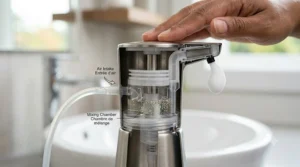
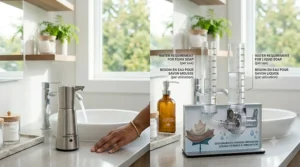
Matching soap to pump. A foaming dispenser has a small mesh chamber that mixes air with soap as it’s pumped — that’s the only thing creating the foam, not the formula itself. If you want to use a plain liquid soap in a foam dispenser, you generally need to dilute it, roughly one part liquid soap to three or four parts water, then top up as it runs low. Skipping this step is the single most common reason people think a “foam dispenser is broken” when it’s really just been filled with undiluted soap.
Canadian cold-weather storage matters. If your soap lives in an unheated mudroom, garage, or three-season cottage, natural formulas with fewer synthetic stabilizers can thicken, separate, or even partially freeze below roughly 0°C, which clogs the foam pump’s fine mesh. Bring refills indoors to a heated space for a few hours before refilling a dispenser that’s been sitting in the cold.
Preventing clogs. Hard water (common across much of Ontario, Manitoba, and the Prairies) can leave mineral buildup in a foam pump’s mesh over time, slowing or stopping the foam action. A monthly rinse with warm water and a splash of white vinegar through an empty pump head clears this without needing to replace the whole dispenser.
Common first-30-day mistake: shaking a sluggish foam bottle, assuming that fixes weak foam. It doesn’t — weak foam almost always means the soap is too concentrated (needs more dilution) or the pump’s air-mixing screen is clogged, not that the bottle needs a shake.
Real Canadian Households: Matching Soap to Your Routine
The Toronto condo dweller. Limited under-sink storage and a strong push to cut down on plastic mean a refill-pouch system like Method’s foaming concentrate makes sense — one reusable bottle, periodic small pouches, minimal clutter.
The rural Manitoba farmhouse. A mudroom door sees grimy hands after outdoor chores all winter, while the kitchen sink deals with cooking grease daily. A foaming antibacterial option like Dial Complete at the mudroom door for quick post-chore washing, paired with a thicker liquid soap like Softsoap at the kitchen sink for grease, covers both jobs without overpaying for antibacterial everywhere.
The Vancouver eco-conscious family. Prioritizing EWG-verified, Canadian-made ingredients across the board, this household standardizes on ATTITUDE’s foam and liquid lines throughout the house — one brand, one ingredient philosophy, less decision fatigue at the store.
Common Mistakes When Buying Hand Soap in Canada
- Comparing bottle price instead of cost-per-wash. A cheaper bottle that uses three times as much product per pump can end up costing more over a month.
- Assuming “antibacterial” automatically means better hygiene. For typical household use, antibacterial soaps are generally considered unnecessary, with regular soap and proper technique already removing germs effectively in most everyday situations; antibacterial formulas matter more in specific situations, like caring for someone immunocompromised.
- Buying a refill-only pack without owning the matching pump bottle. Concentrate pouches and large refill jugs assume you already have a compatible dispenser — check before ordering.
- Treating all “natural” claims as equal. Third-party verification (EWG Verified, Leaping Bunny) means something different than marketing language with no outside check.
- Ignoring Amazon.ca shipping realities. Some listings ship from U.S. warehouses with longer delivery windows to Canadian addresses, and orders under $35 CAD won’t qualify for free non-Prime shipping.
Long-Term Cost & Refill Economics in CAD
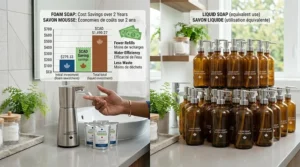
Here’s where foam soap’s efficiency really shows up. Commercial-use data suggests a single pump of foam soap dispenses roughly a quarter to a third the volume of a single pump of liquid soap, which is why high-traffic commercial washrooms increasingly default to foam. A typical foam pump dispenses around 0.25–0.3 mL of product compared to roughly 1.0 mL for a liquid pump, making foam the more economical choice per wash in volume terms.
Translated to a Canadian household: a $14 CAD foam refill that lasts a busy family of four six to eight weeks can work out to a lower cost-per-wash than a $7 CAD liquid bottle that’s empty in two weeks. The catch is that liquid soap’s thicker formula is doing more physical work per wash (the scrubbing-lather effect noted earlier), so the better long-term value depends on what you’re optimizing for — pure cost-effective hand washing favours foam; thorough grease-cutting favours liquid. Bulk refill formats (like ATTITUDE’s 2-litre liquid option) push the cost-per-wash down further for either format, since you’re paying mostly for concentrate rather than packaging.
Canadian Regulations & Safety Standards
A few rules specific to the Canadian market are worth knowing, especially if you’re comparing products across Amazon.ca and Amazon.com:
- Bilingual labelling is mandatory. Cosmetic labels sold in Canada must include the product identity in both English and French, along with net quantity in metric units and contact information for the seller, under the Food and Drugs Act and the Consumer Packaging and Labelling Act.
- Antibacterial claims need separate authorization. A soap making a “kills bacteria” or antiseptic claim is generally reviewed differently than a standard cosmetic cleanser by Health Canada — look for a numbered authorization on the label rather than taking the word “antibacterial” at face value.
- Fragrance allergen disclosure is tightening. Starting in 2026, Health Canada requires that specific fragrance allergens above certain concentration thresholds be listed individually on cosmetic labels rather than hidden under the generic term “fragrance” or “parfum”, which is good news if anyone in your home has sensitivities.
- Quebec has stricter French-language rules. Under Quebec’s Bill 96, French text must be at least as prominent as English on packaging sold in that province, which can mean slightly different label layouts depending on where a product is sourced.
For general hand-hygiene guidance, the Public Health Agency of Canada’s hand hygiene page and the Canadian Centre for Occupational Health and Safety are both solid, plain-language references.
Features That Actually Matter (And Those That Don’t)
Actually matter:
- Pump-and-dispenser compatibility (foam vs. liquid mechanics)
- Third-party ingredient verification (EWG Verified, Leaping Bunny) if that’s a priority
- Refill format and bottle size relative to your household’s wash frequency
- Bilingual label compliance as a baseline trust signal for Canadian-sold products
Don’t matter as much as the bottle suggests:
- “Kills 99.99% of bacteria” marketing for everyday, non-medical handwashing
- Exotic scent names that don’t reflect meaningfully different formulas
- “Luxury” or “spa-grade” branding language on what is, chemically, a fairly simple surfactant product

❓ FAQ
❓ Is foam soap or liquid soap better for killing germs?
❓ Can I use liquid soap in a foaming soap dispenser refill?
❓ Does Amazon.ca ship hand soap to all Canadian provinces?
❓ Which hand soap lasts longer, foam or liquid?
❓ Is antibacterial foam soap necessary for everyday use in Canada?
Conclusion
There’s no single winner in the foam soap vs liquid soap debate — there’s just a better fit for your specific sink. Foam soap wins on speed, cost-per-wash, and kid-friendliness; liquid soap wins on built-in scrubbing action and grease-cutting power for kitchens. For most Canadian households, the smartest setup is actually a mix: foam at the bathroom sink for quick, frequent washing, and a richer liquid formula at the kitchen sink where hands need real degreasing.
If ingredient transparency and supporting Canadian manufacturing matter to you, ATTITUDE’s foam-and-liquid pairing is hard to beat. If you’re optimizing purely for cost, Softsoap’s liquid line and Dial’s foam refills both deliver reliable performance at a genuinely low price point. And if you’re trying to cut down on plastic waste without changing your routine, Method’s and J.R. Watkins’s refill-pouch systems are worth the small habit change.
Whichever bottle ends up at your sink, the research is clear on one thing: a thorough 20-second wash matters more than which format you’re holding
Recommended for You
- Best Foaming Hand Soap in Canada 2026: Top 7 Picks Reviewed
- 7 Best Kitchen Hand Soap Grease Cutting Options in Canada (2026)
- 7 Best Natural Antibacterial Hand Soaps in Canada (2026)
Disclaimer: This article contains affiliate links. As an Amazon Associate, I earn from qualifying purchases. If you purchase products through these links, we may earn a small commission at no additional cost to you. Prices are shown as CAD ranges only and were accurate at the time of research — always check Amazon.ca for current pricing and availability.
✨ Found this helpful? Share it with your friends! 💬🤗
